REVIEW · SEVILLE
Sevilla Daily Bike Tour
Book on Viator →Operated by All Of Seville · Bookable on Viator
Seville clicks into place fast when you pedal. This Sevilla daily bike tour is a smart way to see a lot—cathedral area, Giralda views, the Alcázar zone, and major park stops—without the stop-and-start of walking. You also get the kind of local context that turns names like Archivo General de Indias into something you actually remember.
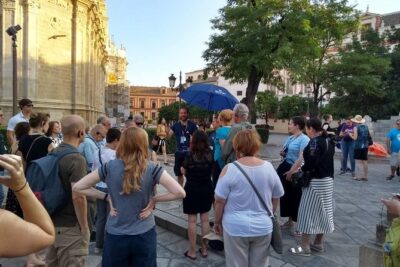
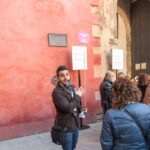
I especially like the small group size (max 15), which keeps things calm and lets your guide adjust the pace to your fitness. In tours with guides like Emilio and Fernando, the riding stays easy, and the storytelling has humor, not just dates.
One thing to consider: several big stops are ticketed separately. Archivo General de Indias is included, but places like the Catedral de Sevilla, Torre Giralda, and Real Alcázar are marked as not included, and the tour also depends on good weather.
In This Review
- Key highlights worth your attention
- A Seville bike tour that shows you the city map
- Bikes, group size, and why the pace feels right
- Triana’s oldest church: Iglesia de Santa Ana (Stop 1)
- San Telmo and the port neighborhood vibe: Palau de San Telmo (Stop 2)
- The Royal Tobacco Factory: Real Fábrica de Tabacos (Stop 3)
- The cathedral zone: Catedral de Sevilla (Stop 4)
- Archivo General de Indias: the one included major stop (Stop 5)
- Giralda: Torre Giralda and what used to be a minaret (Stop 6)
- Real Alcázar: Europe’s oldest palace still in use (Stop 7)
- Murillo Gardens and the Columbus Monument pause (Stop 8)
- Torre del Oro: the golden-tile river landmark (Stop 9)
- Plaza de Toros de la Maestranza: the bullring’s historical weight (Stop 10)
- Parque de María Luisa and the Plaza de América area (Stop 11)
- Plaza de España: the 1929 showpiece square (Stop 12)
- Tickets, time, and how to get the most from the included stops
- Weather, timing, and when to book
- Who this bike tour is best for (and who should skip it)
- Should you book the Sevilla Daily Bike Tour?
- FAQ
- How long is the Sevilla daily bike tour?
- How much does it cost?
- Is the tour in English?
- How many people are in the tour?
- Where does the tour start and end?
- Do I need tickets for the stops?
- Are bikes and the tour provided with a mobile ticket?
- What’s the weather situation?
- What’s the cancellation policy?
Key highlights worth your attention
- A flat, easy ride pace that suits most people (including first-timers to Seville and bike tours)
- Small groups so you can ask questions and actually hear the answers
- One included major museum stop: Archivo General de Indias
- Mix of architecture and everyday neighborhoods like Santa Ana in Triana and the port area around San Telmo
- Big “slow down” breaks at Parque de María Luisa and Plaza de España
- Local guide energy you’ll feel in places like the cathedral complex, Giralda, and the river views
A Seville bike tour that shows you the city map
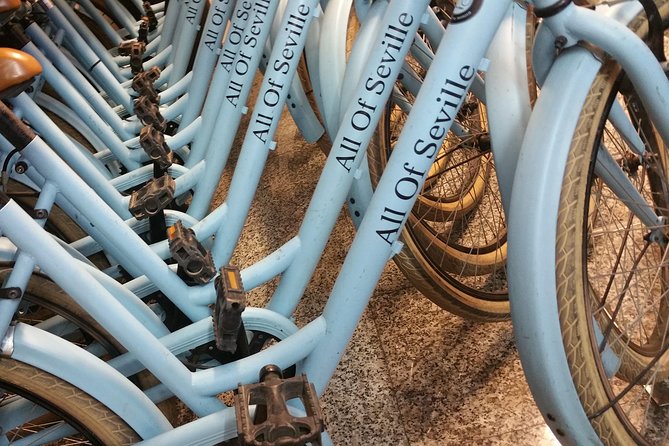
If you’ve ever arrived in Seville, looked at a huge list of sights, and then realized you’ll spend half your day crossing streets… this tour is the fix. In about 2 hours 40 minutes to 3 hours, you cover a lot of ground with minimal fuss, and you get an orientation that makes the rest of your trip easier.
The meeting point is C. Arjona, 8, Casco Antiguo, 41001 Seville. You’ll ride from there and return to the same spot. It runs in English, uses a mobile ticket, and you’ll want to plan ahead since it’s commonly booked about 10 days in advance.
You can also read our reviews of more cycling tours in Seville
Bikes, group size, and why the pace feels right
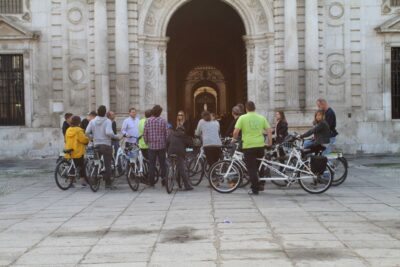
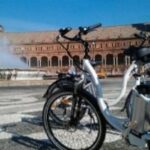
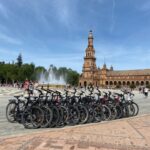
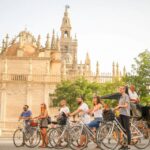
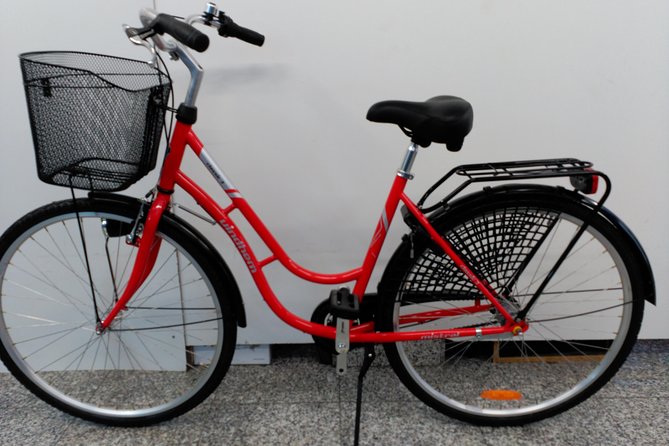
This tour keeps the group small—up to 15 people—and that changes the vibe. You’re not stuck behind a parade of strangers, and guides can adjust to how you’re feeling on the day.
From the way guides like Emilio and Milena handle the ride, the practical expectation is clear: the cycling is not strenuous and the route is designed to be easy to follow. You’ll still get plenty of chances to stop, look, and ask questions. And if you’re traveling with kids, or you simply don’t want to rush, the pacing usually works out better than a walking-only plan.
Triana’s oldest church: Iglesia de Santa Ana (Stop 1)
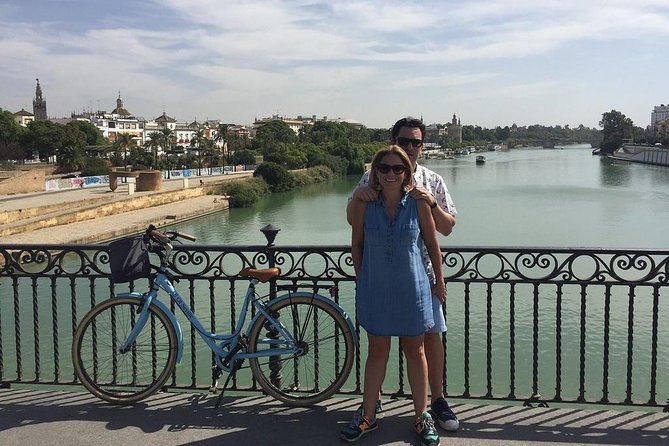
Your first major stop is Iglesia de Santa Ana, described as the oldest church in Seville. It dates back to the 13th century and is connected to King Alfonso. It’s also placed right in the heart of Triana, so you’re not just visiting a landmark—you’re stepping into a neighborhood atmosphere.
What makes this stop worth it is how the church functions as a real starting point. You get oriented to Triana’s vibe, then you layer in what you’re seeing with context about altarpieces and the setting around the church.
Practical note: it’s listed as 10 minutes, and admission isn’t included. If you want an interior visit, plan for a separate ticket.
San Telmo and the port neighborhood vibe: Palau de San Telmo (Stop 2)
Next up is the Palau de San Telmo, tied to Seville’s historic port area. The stop connects to the appearance of the cult of San Pedro González Telmo around the year 1600, and it’s linked with the old convent of Santo Domingo.
This isn’t a stop where you’ll stare at one single thing for a long time. It’s more of a story stop: you learn why the building matters and how Seville’s religious and maritime history are tangled together.
Again, it’s short—about 10 minutes—and admission isn’t included.
The Royal Tobacco Factory: Real Fábrica de Tabacos (Stop 3)
Then comes one of the most striking industrial landmarks in the city: Real Fábrica de Tabacos, the Royal Tobacco Factory. It was the headquarters of Europe’s first large tobacco factory and is often described as the major industrial warehouse of 18th-century Spain.
This is one of those Seville stops that broadens your view. The city isn’t only churches and palaces. You’re also seeing the scale of industry and trade that helped shape wealth and power.
Time here is about 15 minutes, and it’s listed with admission not included. Even if you don’t go in, the exterior and the explanation help you place the building in the bigger Seville story.



The cathedral zone: Catedral de Sevilla (Stop 4)
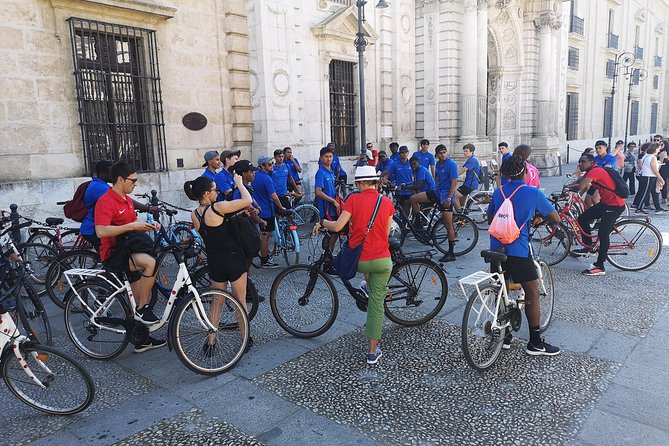
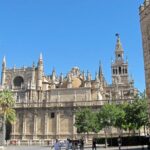
You’ll reach Catedral de Sevilla, famous as the largest Gothic cathedral in the world and a UNESCO World Heritage Site since 1987. This is where Seville’s monumental scale shows up immediately.
The tour keeps the stop to around 15 minutes, which means it’s more about getting oriented and understanding what you’re looking at than taking a long, slow museum-style visit. If you want to spend extra time inside, you’ll likely need to plan that separately, since admission isn’t included here.
Still, this stop works well because it sets up the next two: Giralda and the Real Alcázar area.
Archivo General de Indias: the one included major stop (Stop 5)
Here’s a big practical win: Archivo General de Indias is the stop with admission included. It’s tied directly to understanding America’s history and the economic and cultural relationships between Europe and the Americas.
If you’re the type who likes to connect buildings to real documents, this one feels like a high-value inclusion. You spend about 15 minutes focused on what the archive represents—how records helped bridge continents separated by the ocean.
If you do go in, this is often the stop that makes the tour feel more than just a highlights loop. It gives you a deeper anchor for what you’ll be thinking about later in Seville.
Giralda: Torre Giralda and what used to be a minaret (Stop 6)
From there, you roll into Torre Giralda, connected to the earlier main mosque on this site. The description explains that once the cathedral took shape, the minaret was ordered to be built, and that’s essentially how the Giralda you see today originated.
Time: about 15 minutes. Admission isn’t included, so treat this stop as a look-and-learn moment unless you decide to add ticket time separately.
The best part is the perspective shift. You’re not just seeing a tower. You’re seeing how Seville’s layers overlap—Islamic design influences feeding into later Christian architecture.
Real Alcázar: Europe’s oldest palace still in use (Stop 7)
Next is the Real Alcázar de Sevilla, another UNESCO World Heritage Site. It’s described as the oldest palace in use in Europe, with origins going back to the 11th century, when Muslim authorities built a fortress in a strategic area of Seville.
This stop is about 15 minutes and listed with admission not included. If you have tickets planned, it can work great. If not, the explanation helps you understand why this place is so visually overwhelming—so even an exterior or quick look feels meaningful.
Also, if you’re traveling in the heat, the tour’s structure helps. You’re not stuck doing a long wandering palace day with zero breaks. You see it, you learn it, and then you can choose how deep to go later.
Murillo Gardens and the Columbus Monument pause (Stop 8)
A calmer interlude follows at Jardines de Murillo. Here you can spot the Columbus Monument on Paseo de Catalina de Ribera, plus a statue connected to Rodrigo Díaz de Vivar, the Cid Campeador, on Avenida del Cid.
Time is about 15 minutes, and it’s free. This is a nice moment to reset your eyes between heavy hitters like cathedral and palace. If you like scenic breaks that still connect to famous Seville stories, this one works.
Torre del Oro: the golden-tile river landmark (Stop 9)
You’ll then pass by Torre del Oro, built in the first third of the 13th century, in the final moments of the Taifa kingdoms. Its Arabic name is given as Borg-al-Azajal, meaning golden tiles that reflected in the river.
This stop is about quick understanding. The tower is short on time—about 15 minutes—and admission isn’t included. But once you know what the name refers to, you’re better at noticing why it’s so memorable along the water.
Plaza de Toros de la Maestranza: the bullring’s historical weight (Stop 10)
Seville’s Plaza de Toros de la Maestranza comes next. It’s described as the oldest bullring in Spain, and it ties into April Fair bullfighting traditions.
Time here is about 15 minutes, with admission not included. Even if you’re not there for bullfighting, it’s still a major cultural landmark in Seville. It’s also a reminder that Seville’s identity isn’t only religious and royal—it’s civic, festival-based, and intensely local.
Parque de María Luisa and the Plaza de América area (Stop 11)
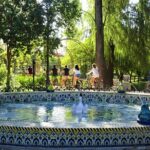
At Parque de María Luisa, you get one of the best mixes in the city: nature, monuments, and open-air history. This stop is free and about 15 minutes.
The park is large—about 40 hectares—and the description mentions places like the Glorieta de Bécquer, the Isla de los Pájaros, Monte Gurugú, and Plaza de América. Even if you don’t walk far, the guide’s explanation helps you see the park as more than a green pause. It’s part of what shaped how Seville presents itself.
Plaza de España: the 1929 showpiece square (Stop 12)
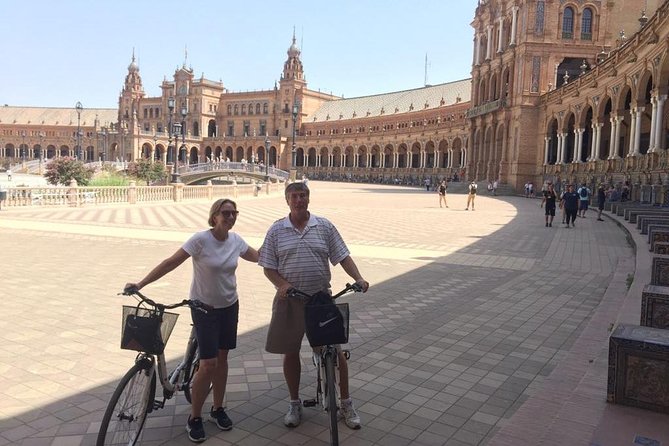
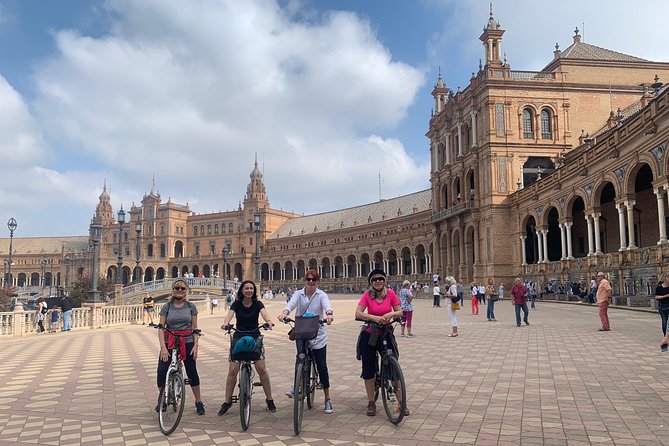
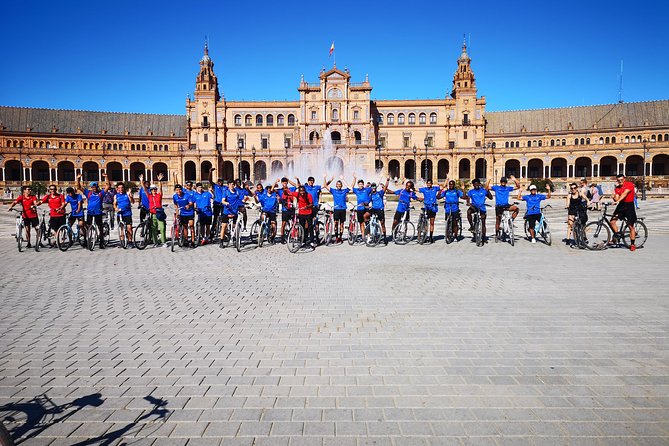
Finally, the ride ends with Plaza de España, set in María Luisa Park. It was designed for the Ibero-American Exposition of 1929 by architect Aníbal González, and it’s described as a unique palace-square.
This stop is about 15 minutes and free. You’ll want to use it wisely. Look from different angles, notice the structure, and take a few photos before you roll back.
It’s a strong final note because the architecture hits fast, and the open space makes it a satisfying end to a mostly “move-and-stop” bike tour.
Tickets, time, and how to get the most from the included stops
The tour is priced at $36.20 per person, and the biggest value angle is how the time is used. You’re paying for access to the route, the bike experience, and the guide’s storytelling across multiple top sites in under three hours.
Here’s the simple ticket reality:
- Archivo General de Indias is marked as admission included.
- Many other stops—like Catedral de Sevilla, Torre Giralda, and Real Alcázar de Sevilla—are listed as admission not included.
- Jardines de Murillo, Parque de María Luisa, and Plaza de España are marked free.
So I’d treat this as an orientation and highlights tour. If you want the full “stroll for hours” version of the cathedral and palace, you’ll still want a separate visit day. But after this ride, you’ll know exactly where to focus.
Weather, timing, and when to book
This is a good weather experience. The tour explicitly requires good weather, and if it’s canceled due to poor weather, you’ll be offered another date or a full refund.
Timing is also practical. One guide-style detail from real-world use: riding in the evening can feel easier in hot months because things cool down and crowds can be lighter. If you can choose a cooler time of day, do it.
Because it’s commonly booked about 10 days in advance, I recommend locking your date early, especially if you’re visiting in peak season or on weekends.
Who this bike tour is best for (and who should skip it)
This tour is a strong match if you:
- want a fast way to understand Seville in your first days
- like guided storytelling and prefer learning while moving
- want to see major sights without the long walking marathon
- enjoy small groups and a pace that can flex
It might be less ideal if you:
- want long museum time at only one site
- hate bike rides or you have very limited mobility and need lots of downtime (the tour says most travelers can participate, but bikes still require comfort with the ride)
- are planning to rely on included tickets for everything (only one major admission stop is included)
Should you book the Sevilla Daily Bike Tour?
I’d book it if your goal is getting oriented and seeing the big names without wasting hours in transit. The combination of small group, easy pace, and guides like Emilio and Fernando who bring humor and context makes it feel like more than a checklist ride.
Before you go, decide what you want to do later. Use the tour to find your priorities—cathedral vs. Alcázar vs. parks—and then build your longer visits around that. If you’re traveling in heat, aim for a cooler time of day and enjoy the short, scenic stops like Parque de María Luisa and Plaza de España.
FAQ
How long is the Sevilla daily bike tour?
The tour runs about 2 hours 40 minutes to 3 hours.
How much does it cost?
It costs $36.20 per person.
Is the tour in English?
Yes, it’s offered in English.
How many people are in the tour?
The group size is limited to a maximum of 15 travelers.
Where does the tour start and end?
It starts at C. Arjona, 8, Casco Antiguo, 41001 Sevilla, Spain and ends back at the meeting point.
Do I need tickets for the stops?
Archivo General de Indias has admission included. Most other listed stops are marked as not included, while Parque de María Luisa, Plaza de España, and Jardines de Murillo are free.
Are bikes and the tour provided with a mobile ticket?
Yes. You’ll use a mobile ticket, and you can participate with most travelers.
What’s the weather situation?
The tour requires good weather. If it’s canceled due to poor weather, you’ll be offered a different date or a full refund.
What’s the cancellation policy?
You can cancel for a full refund up to 24 hours in advance. Cancellations within 24 hours aren’t refunded.