REVIEW · SEVILLE
Seville: 3–Hour Sightseeing Tour
Book on GetYourGuide →Operated by Centerbici · Bookable on GetYourGuide
Seville in 2.5 hours feels like speed dating. You zip past key landmarks on a rental bike, then slow down when your bilingual guide tells the stories that make each square click into place. I also like how the route is laid out so you get both the classic postcard stops and the context for why they matter.
One thing to consider: the bike experience can be inconsistent. Most of the time the ride is smooth enough, but a few recent experiences flagged older or poorly maintained bikes, and once a cancellation happened when there weren’t enough usable bicycles at the shop.
In This Review
- The Route and What Makes It Work
- Key Stops You’ll Actually Remember
- Getting Set Up at Centerbici (and Why the Start Matters)
- Rolling Into Seville’s Old Patio House
- Plaza del Salvador to Plaza Nueva: How the City’s Core is Structured
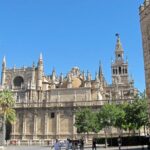
- Cathedral Area and the Giralda: Orientation Before You Wander
- The Tobacco Factory: Industry Meets Architecture
- Prado de San Sebastián, Plaza de España, and Maria Luisa Park
- New York Dock, Real Maestranza, and Torre del Oro
- Ending at the Mushrooms of Plaza de la Encarnación (Modern Seville)
- Price and Value: Is $35 Reasonable for 2.5 Hours?
- Bike Reality Check: What to Expect on Two Wheels
- Who This Tour Fits Best (and Who Should Skip It)
- Should You Book This Seville Bike Tour?
- FAQ
- FAQ
- How long is the Seville sightseeing tour?
- Where do I meet for the tour?
- Is bike rental included?
- What languages are available for the guide?
- Is the tour suitable for people with mobility impairments?
- Can I cancel for a full refund?
The Route and What Makes It Work
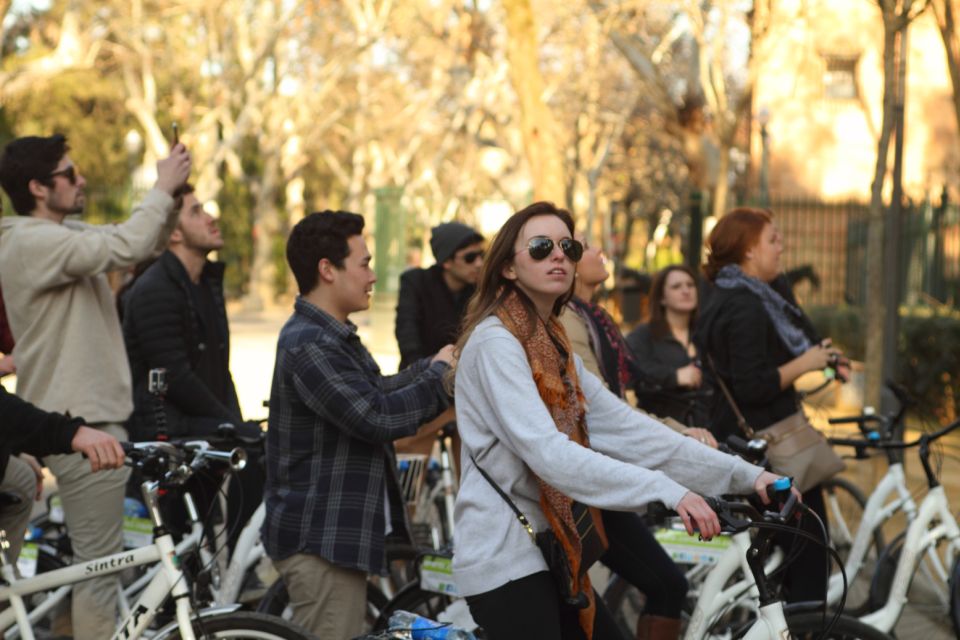
This is a 3-hour sightseeing tour listed at about 2.5 hours on the clock, built for orientation and momentum. You’re not doing a museum marathon. You’re getting a well-paced circuit that strings together Seville’s most recognizable monuments—plus the kind of trivia that turns photos into memories you can explain later.
The tour starts from a 19th-century house, then moves outward to the core historic areas: plazas around Plaza del Salvador, Plaza de San Francisco, Plaza Nueva, and the Cathedral zone near Avenida de la Constitución and the Giralda. After that comes a classic contrast stretch: the old tobacco factory, Prado de San Sebastián, and then the showpieces of the river-adjacent grand project era—Plaza de España and Maria Luisa Park—before you head toward the river landmarks and finish at the Mushrooms of the Plaza de la Encarnación.
Key Stops You’ll Actually Remember
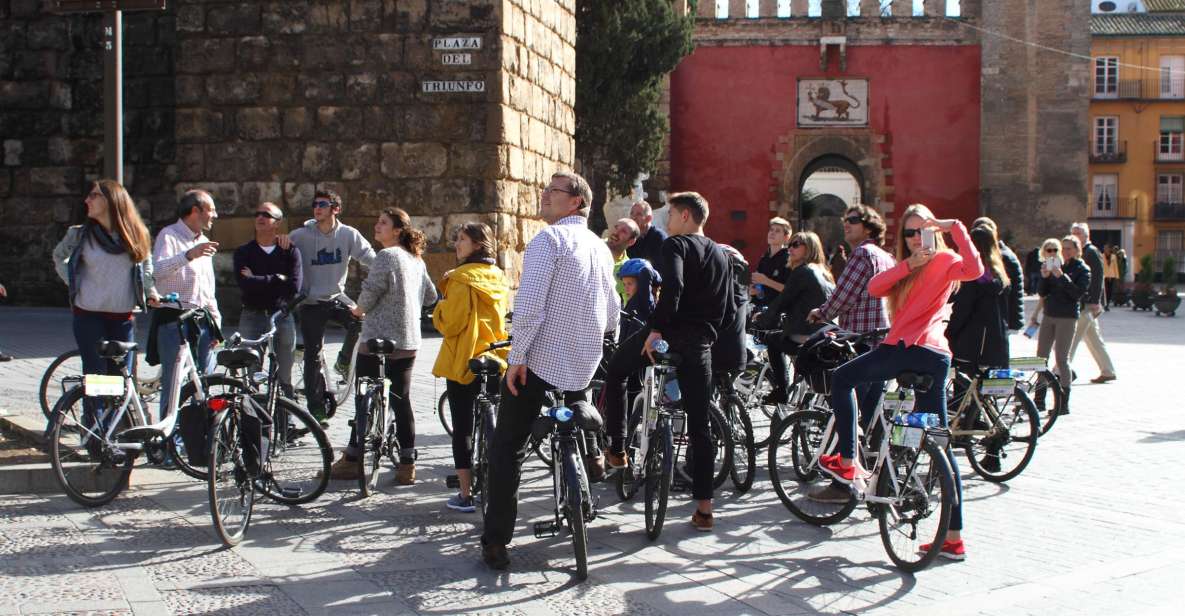
- Plaza del Salvador, Plaza de San Francisco, and Plaza Nueva to understand how Seville’s center is organized around its civic and religious power
- The Giralda area for landmark orientation, not just another photo stop
- The old tobacco factory to connect buildings to industry and everyday life
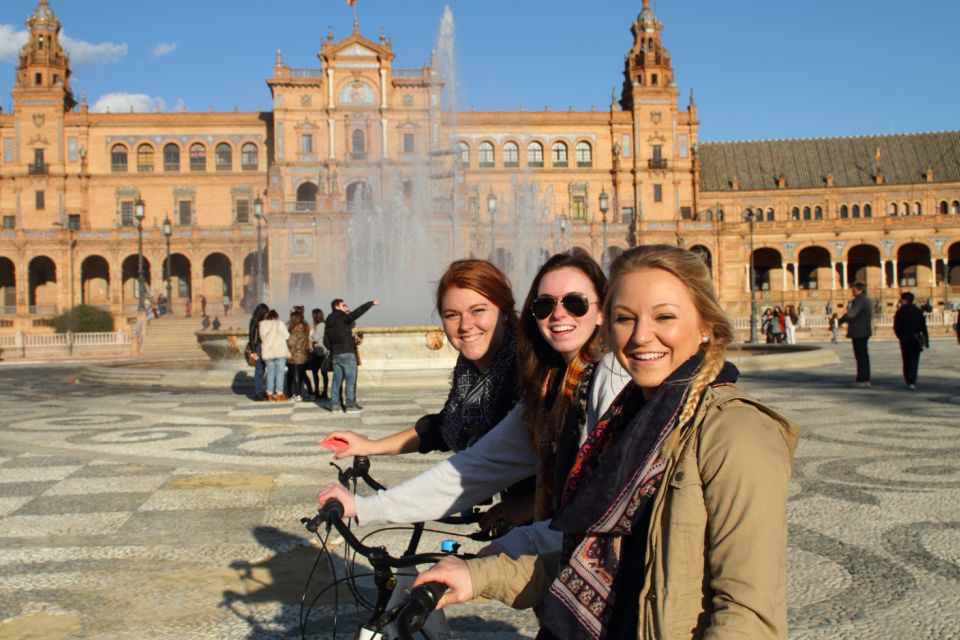
- Plaza de España and Maria Luisa Park to see the big, ceremonial vision behind Seville’s grand spaces
- Real Maestranza and Torre del Oro for iconic river-side identity
- The Mushrooms of Plaza de la Encarnación to end with a modern twist
You can also read our reviews of more tours and experiences in Seville.



Getting Set Up at Centerbici (and Why the Start Matters)
Your meeting point is Centerbici, at C/ Espronceda, 5 – 41004 – Sevilla. It’s a practical choice: you’re not starting in the middle of nowhere. You’re starting where bikes are handled, helmets are available for children, and you can get oriented fast.
The tour includes bike rental, a water bottle, and a map. I like that combo. A lot of city tours hand you a phone-screen plan and call it done. Here, you’re given a physical map and water from the jump, which helps you actually follow along without stopping to reload directions every time the route shifts.
Bring your ID. That’s specifically called out, so don’t assume you can show a digital copy and be fine. If you’re traveling light, toss your passport or other ID in a secure pocket before you head over.
Rolling Into Seville’s Old Patio House
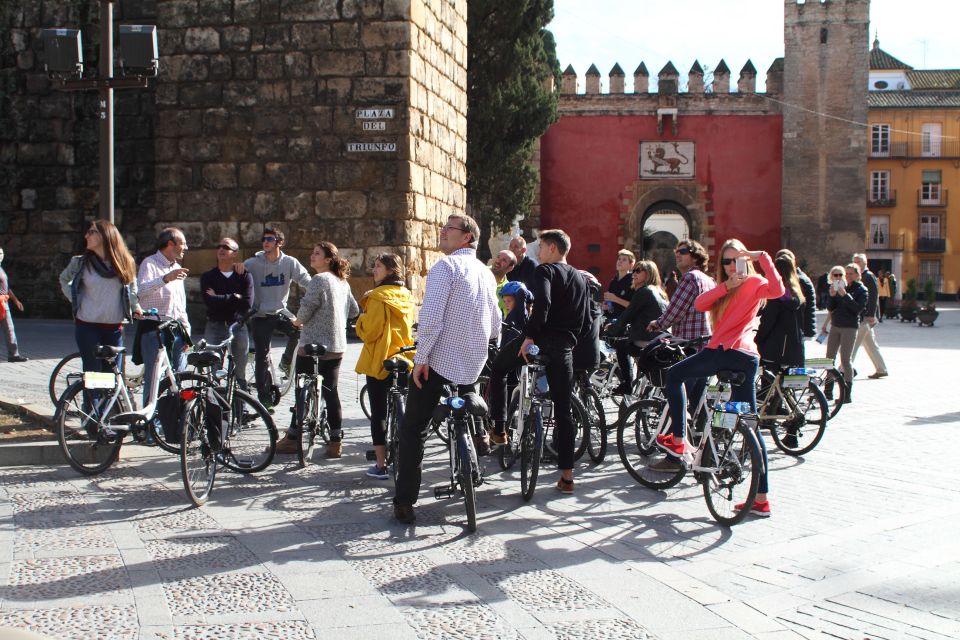
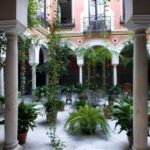
Before you hit the big monuments, you begin at a 19th-century house that you can view through a typical Sevillian patio. This part might sound small, but it’s a smart opener.
Seville is easier to understand when you see how everyday domestic architecture works. A patio isn’t just a cute courtyard. It’s a climate tool and a social design. Starting here helps you decode what you’ll see later: Seville’s buildings often make sense when you understand how people lived inside them, not just how they looked from the street.
And because you’re on bikes, you can move on quickly once the guide finishes the setup. The tour keeps a steady rhythm: short context, then a target location.
Plaza del Salvador to Plaza Nueva: How the City’s Core is Structured
The route focuses on several central plazas—Plaza del Salvador, Plaza de San Francisco, and Plaza Nueva—located near major civic spots like City Hall. If you want one reason this works, it’s that these squares sit close enough that the guide can connect them into one story.
What I’d watch for on this stretch is how the plazas function. You’ll notice the way Seville’s power shifts between religious landmarks and civic life. The names alone tell you you’re in the center of things, but the guide’s explanations help you understand the layout and what each place historically represented.
Also, this is where your guide’s narration matters most. If you’ve ever felt like Seville’s center is a beautiful blur, a guided route prevents that. You get fewer stops, explained better.
Cathedral Area and the Giralda: Orientation Before You Wander
From the center, you head toward Avenida de la Constitución, the Cathedral zone, and the Giralda. Even if you’ve seen the Giralda in photos, the guided approach helps because you’re not just standing at the monument—you’re learning the surrounding geography and seeing the landmark in relation to nearby squares and routes.
This is a classic place where people can over-plan and accidentally under-see. The bike format solves that. You move through the city faster than walking, but you still get to pause at meaningful points instead of treating the Cathedral area like just a backdrop.
If you’re the type who likes to return later on your own, this stop is also a built-in orientation session. You’ll know where to go back to and which streets you can skip.




The Tobacco Factory: Industry Meets Architecture
One of the most memorable highlights is the visit to the old tobacco factory. This is where the tour shifts from postcard landmarks into the kind of Seville that explains how people worked, not just how they posed.
Industrial buildings can be hard to appreciate when you only see their exterior. A guided stop helps you notice what you’d otherwise miss: how a massive facility fits into a city, how it shaped daily rhythms, and how that history lingers in the architecture.
This is also a high-value stop because it creates variety. Most walking tours focus heavily on churches and plazas. Here, you’re given a different angle on what made Seville tick.
Prado de San Sebastián, Plaza de España, and Maria Luisa Park
After the tobacco factory, you move toward Prado de San Sebastián. Think of this as a transition corridor that connects areas rather than a single highlight you should obsess over. Still, it’s useful because it helps you understand how Seville’s big urban spaces link together.
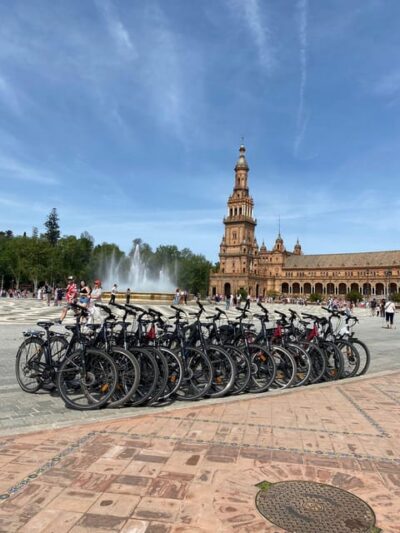
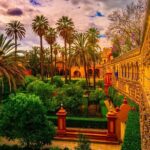
Then the tour hits Plaza de España and Maria Luisa Park. These are major “wow” spaces, but the key is that this tour doesn’t treat them like one photo moment and done. The guide’s stories are what turn these big open areas into something you can place and remember.
Here’s what I’d pay attention to: the sheer scale and the intentional design. Plaza de España and the surrounding park areas are the kind of sites where you can easily walk around for an hour on your own and still feel like you only saw the edges. With the tour’s structure, you get a quick understanding of how the space is meant to feel—ceremonial, theatrical, and organized.
If you want deeper time inside either spot, plan to come back after the tour. On this one, your job is to get the map of meaning.
New York Dock, Real Maestranza, and Torre del Oro
Next comes the river-adjacent identity stretch: New York dock, Real Maestranza, and Torre del Oro.
Even without turning this into a full history lesson, it’s valuable to get these landmarks grouped together. They form a visual story of Seville’s relationship with trade, defense, and spectacle. Torre del Oro alone is iconic, and seeing it in sequence with nearby landmarks helps you connect the dots instead of treating every stop as a separate postcard.
Practical note: because you’re biking, you’ll likely get an overview rather than long lingering. That can feel fast if you love slow travel. But it also means you leave with a shortlist of what’s worth revisiting.
Ending at the Mushrooms of Plaza de la Encarnación (Modern Seville)
The tour finishes with the Mushrooms of the Plaza de la Encarnación, explicitly as a contrast point between historic and avant-garde Seville.
I like tours that end this way because your brain is less likely to file everything under the same category. When the route closes with something modern and sculptural, it turns your whole day into a storyline: old patios and grand plazas, then industry and river landmarks, then a contemporary stop that feels like a new chapter.
This is also a strong finishing strategy for photos. By the end, you’re warmed up, you know where you are, and you don’t feel like you’re starting from zero.
Price and Value: Is $35 Reasonable for 2.5 Hours?
At $35 per person for about 2.5 hours, this tour is priced like a value-forward “see a lot with context” option.
You’re getting several things bundled:
- bike rental
- bilingual live guide
- water bottle and map
- skip-the-ticket-line benefit
In real terms, the cost isn’t just paying for sightseeing. You’re paying for someone to connect the dots between monuments so you don’t waste your limited time wandering without direction.
If you only cared about getting photos, you could cobble together a route on your own. But if you want explanations that help you understand what you’re looking at, the guide’s narration is the difference between visiting Seville and learning Seville fast.
Bike Reality Check: What to Expect on Two Wheels
I want to be straight with you here because the reviews point to a real variable: the bikes aren’t guaranteed to be new.
Some experiences praised the guide highly while noting the bikes weren’t the freshest. Others flagged bikes that were older or not well cared for, with one report that there weren’t enough intact bicycles available—resulting in a cancellation. And in a smaller-group scenario, a booking that expected a German ride was combined with another group and explained in English.
So what should you do with that info?
- Do a quick bike check the moment you’re assigned one. Test brakes and make sure the bike feels stable before you roll out.
- Wear shoes that handle city stops and starts. You’ll be riding close enough to traffic and curbs that comfortable control matters.
- If you’re booking for a specific language, know that small-group dynamics can change how the guide speaks. The tour is offered in Spanish, English, French, Italian, Dutch, but execution can depend on group size.
The upside is that the guide quality seems to be the real strength of this tour. Names that came up include Sebastian and Alexandro, and both were praised for being nice, listening, and adapting to what the group wanted to see.
Who This Tour Fits Best (and Who Should Skip It)
This tour is a good fit if you:
- want a fast introduction to Seville’s biggest sights
- like learning stories behind monuments rather than just walking by them
- are comfortable riding a bike in a city
- appreciate a guide who can adapt and keep you moving without feeling rushed
It’s probably not the best fit if you:
- need mobility-friendly access. The tour is explicitly listed as not suitable for people with mobility impairments.
- are very sensitive about bike maintenance and want brand-new equipment every time
- plan to spend lots of time inside museums or want long, slow stops. This is designed as a guided circuit.
Should You Book This Seville Bike Tour?
I’d book it if your main goal is smart coverage plus explanations. Seville’s center can feel like a beautiful maze, and this route gives you a coherent path through the Cathedral area, the tobacco factory, grand plazas, river-side landmarks, and a modern finale at Plaza de la Encarnación.
I’d think twice if you’re anxious about equipment quality. The bike issue shows up in the feedback, including one cancellation tied to missing intact bikes. If you’re comfortable doing a quick check on arrival and you’re flexible about what you might get from the ride, you’re likely to enjoy the experience. And if your top priority is comfort over speed, you might consider a slower, walking-only plan.
FAQ
FAQ
How long is the Seville sightseeing tour?
The tour duration is 2.5 hours (listed as 3 hours).
Where do I meet for the tour?
You meet at Centerbici store, C/ Espronceda, 5 – 41004 – Sevilla.
Is bike rental included?
Yes. Bike rental is included, and helmet rental for children is also included.
What languages are available for the guide?
The live tour guide is available in Spanish, English, French, Italian, and Dutch.
Is the tour suitable for people with mobility impairments?
No, it is not suitable for people with mobility impairments.
Can I cancel for a full refund?
Yes. Free cancellation is available up to 24 hours in advance for a full refund.
If you tell me your travel month and whether you’re comfortable biking, I can help you decide if this is the right pacing for your Seville trip.