REVIEW · SEVILLE
Seville: Tiny-Group Jewish Quarter Discovery Walking Tour
Book on GetYourGuide →Operated by Sevillaconguía · Bookable on GetYourGuide
Seville’s tiny streets carry big stories. On this Santa Cruz walk, I like how the guide ties Jewish life to specific corners like Plaza de Doña Elvira, and then keeps going with cultural threads you can actually picture on the ground. The one catch is that this is a lot of walking through tight lanes and old stone, so you’ll want comfortable shoes and a steady pace.
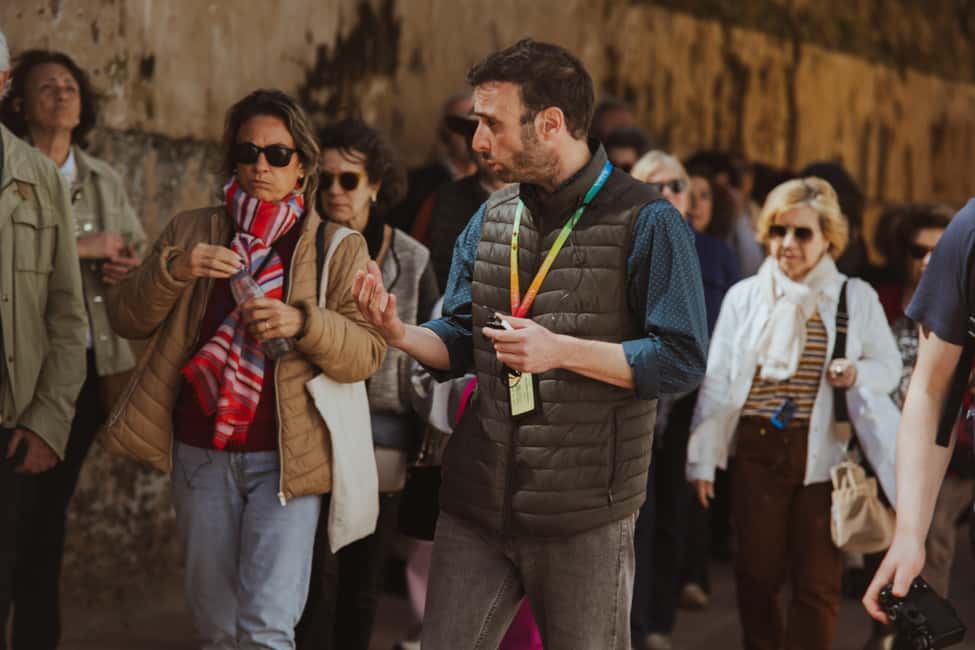
You also get a true guide experience, not a quick drive-by. The tour is set up for a small group, and the comments I’ve seen highlight guides such as Anaïs (strong French, lots of small anecdotes) and Roberto (real knowledge and patient answers to tangential questions), which is exactly what you want for this kind of neighborhood storytelling.
In This Review
- Key things I’d watch for before you book
- Santa Cruz, the Jewish Quarter, and why this walk clicks
- Start point at Plaza del Triunfo: you’ll get your bearings fast
- Patio de Banderas: when architecture becomes part of the story
- Plaza de Doña Elvira, Calle Vida, and Callejón del Agua: the Santa Cruz hits hardest
- Jardines de Murillo: a calmer pocket before the finale
- Iglesia de Santa María la Blanca: finishing with meaning
- Opera and literature links: why famous works belong here
- Small-group format and guides you can learn from (Anaïs and Roberto)
- Price and value: is $46 a fair trade for 90 minutes?
- Timing, pace, and what to bring for comfortable walking
- Accessibility and mobility: check carefully before you go
- Who this tour is best for
- Should you book this Seville Santa Cruz Jewish Quarter tour?
- FAQ
- How long is the Seville Santa Cruz Jewish Quarter discovery walking tour?
- Where does the tour start and end?
- What language is the live tour guide?
- Is the price $46 per person?
- Are entrance fees included?
- What should I bring for the tour?
- Is alcohol allowed during the tour?
- Is the tour suitable for wheelchair users?
Key things I’d watch for before you book
- Small-group feel: better Q&A when the group size is kept tight.
- Jewish Quarter focus in Santa Cruz: street-by-street context, not generic talking points.
- Opera and literature connections: you’ll hear how the neighborhood shows up in famous culture.
- Iconic stops you can find again: Plaza de Doña Elvira, Calle Vida, and Callejón del Agua.
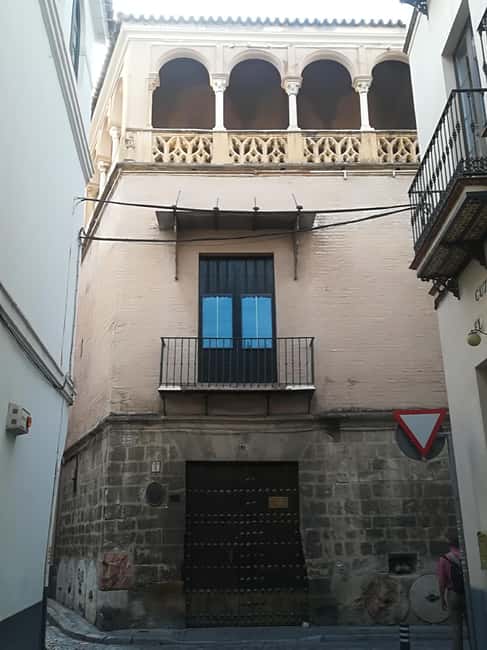
- Andalusian patios and balcony views: traditional architecture is part of the story.
- Finish at Iglesia de Santa María la Blanca: a strong emotional “end point” for the tour route.
Santa Cruz, the Jewish Quarter, and why this walk clicks
Seville can feel like one big show, but the Santa Cruz district works differently. It’s all narrow streets, small squares, and hidden rhythms. This tour makes you slow down enough to notice how the neighborhood layout shapes what people could do here over time.
The “Jewish Quarter discovery” idea matters because it’s not just a name on a map. You’re walking the same kinds of spaces where a community lived—so the guide’s stories land faster. And the tour doesn’t stay locked in the past either. It connects local culture to famous works like Carmen and The Barber of Seville, giving you a reason to remember what you’re seeing beyond dates and labels.
One more thing: this walk stays practical. It’s 1.5 hours, paced with short guided stops, so you’re not stuck in one lecture mode. If you want history plus atmosphere, this format is a good match.
You can also read our reviews of more walking tours in Seville


Start point at Plaza del Triunfo: you’ll get your bearings fast
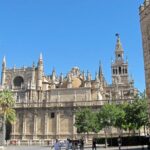
You’ll begin at the foot of the monument to the Virgin Mary, in the center of Plaza del Triunfo, between the Cathedral and the Royal Alcázar. That location is smart because it puts you right where Seville’s major landmarks press close together. It’s easy to find, and it helps you orient the Santa Cruz route from the start.
The first stretch gets you into the quarter’s walking rhythm. You’re not just moving from point A to point B. The guide uses the neighborhood’s layout—bends, side streets, and little open squares—to explain what life might have looked like and how communities left traces.
If you’re the type of traveler who needs to know where you are as you go, you’ll appreciate this start. It also helps on day one of exploring Seville, when your brain is still building a mental map.
Patio de Banderas: when architecture becomes part of the story
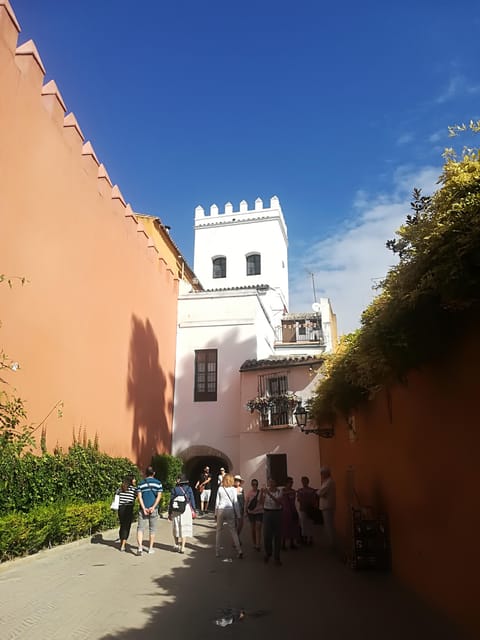
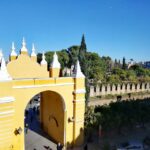
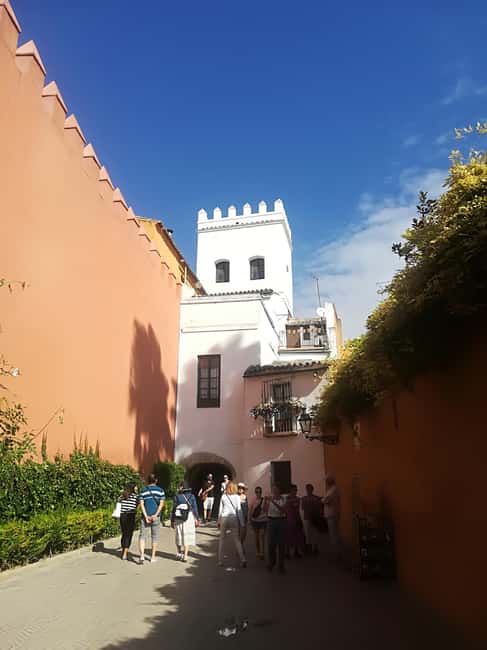
One of the early stops is Patio de Banderas. Even if you’ve seen Andalusian architecture before, patios like this tend to reset your attention. The guide uses these spaces to talk about daily life and how culture shows up in built form—think stone, shadows, and the way courtyards create pockets of calm in a busy city.
This is where the tour’s “small-group + stories” style pays off. A guided visit like this works best when you’re listening for details you might otherwise miss, like how a space supports social life. You’ll spend a short guided chunk here, then keep moving while the neighborhood is still vivid in your head.
What I like about this approach: it doesn’t treat architecture as decoration. It treats it as evidence of how people lived and gathered.
Plaza de Doña Elvira, Calle Vida, and Callejón del Agua: the Santa Cruz hits hardest
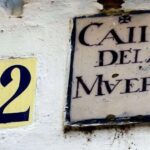
The highlights call out three places that many visitors remember later because they’re so visually distinct: Plaza de Doña Elvira, Calle Vida, and Callejón del Agua. This is where you’ll feel the Santa Cruz personality most strongly—tight lanes, small viewpoints, and the kind of street theater Seville does naturally.
The guide’s job here isn’t to recite facts like a brochure. It’s to connect what you see to the lived experience: the community’s influence on Seville’s history and culture, and how that legacy continues to shape the vibe of the district.
There’s also a romance-and-resilience energy to the storytelling—at least in the way the tour describes its themes. You’ll hear tales framed as intrigue and endurance, not just timelines. That matters because it makes the district feel human instead of museum-like.
Practical note: these streets can feel narrow and slightly crowded, especially around popular photo spots. Go slow through the busier parts and lean into the guide’s pacing. If you rush, you’ll miss half the value.
Jardines de Murillo: a calmer pocket before the finale
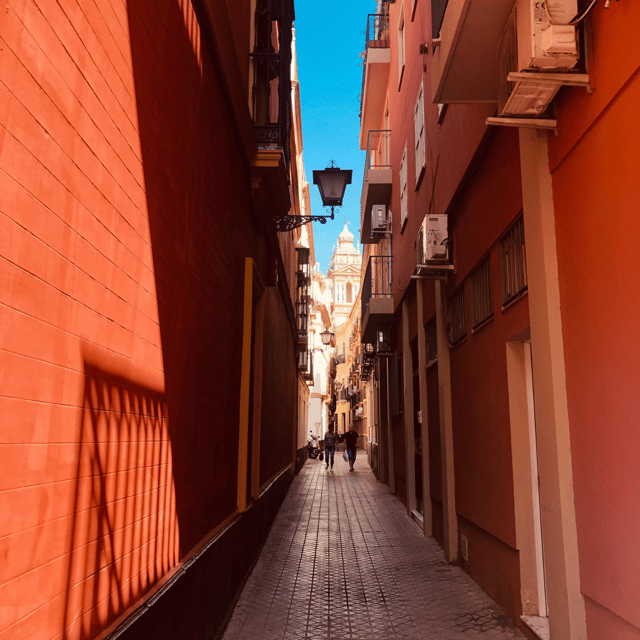
The route continues to Jardines de Murillo, which gives you a breather between the more lane-heavy sections. Garden areas in old quarters often change the mood instantly: you get lighter air, more open sightlines, and a chance to regroup your attention.
This stop works as a transition. Earlier moments are about dense storytelling and architectural texture. Here, the guide can pull back a little, letting you absorb what you already learned while the surroundings soften the pace.
If you tend to get “history-head” after 45 minutes of facts, this kind of pacing is a real benefit. It keeps you from tuning out when your brain wants a rest.





Iglesia de Santa María la Blanca: finishing with meaning
The tour ends at Iglesia de Santa María la Blanca. Ending at a known landmark gives you a clean mental closure. You stop, look, and let the stories you heard earlier snap into a more emotional shape.
It’s also a practical finish: you don’t have to solve your own way out of the quarter. The activity wraps back at the meeting point, so you’re not left wondering how to retrace steps.
If you like tours that create an arc—start with orientation, move through story stops, then land at a place that feels significant—you’ll appreciate this structure.
Opera and literature links: why famous works belong here

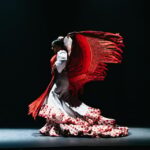
One of the tour’s most distinctive selling points is the connection to the world of opera and literature, including Carmen and The Barber of Seville. That can sound abstract until you hear it explained in the context of the streets around you.
Here’s how it tends to help you as a traveler: Seville is full of famous references. When someone ties those references to actual neighborhoods and the kinds of cultural influences that were present, you can start recognizing themes instead of only collecting titles.
You’re not being asked to study a textbook. You’re getting a set of cultural connections that make later reading or watching feel more grounded. The neighborhood becomes a reference point, not just a background.
Small-group format and guides you can learn from (Anaïs and Roberto)
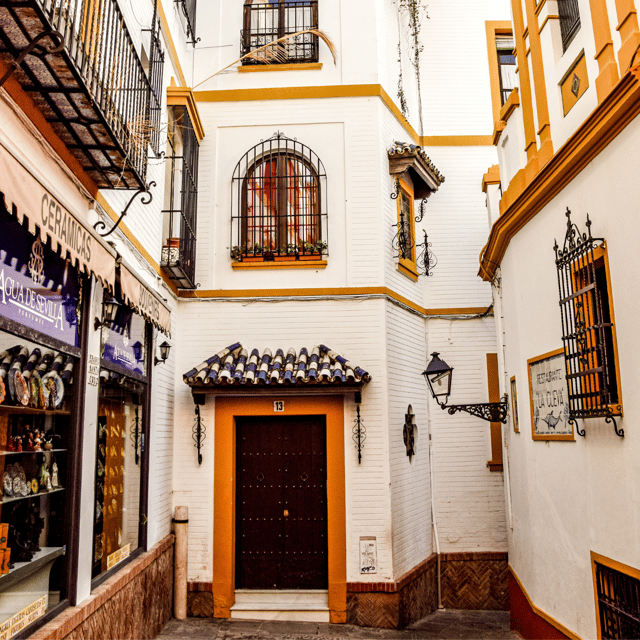
This tour is designed for a tiny group, and that’s not marketing fluff. In a small format, you get time for questions, and the guide can tailor explanations when you’re curious—or when you’re stuck. The notes about guides like Anaïs (excellent French and lots of small anecdotes) and Roberto (real knowledge and accommodating answers to tangential questions) point to the same theme: people don’t just talk at you.
And that matters more in history walks than in many sightseeing tours. Jewish history in Seville involves nuance, and you’ll get more out of a guide who can explain clearly and adjust when you ask follow-ups.
If you’re the kind of traveler who likes to understand the why behind the what, this small-group setup is a big part of the value.
Price and value: is $46 a fair trade for 90 minutes?
At $46 per person, you’re paying for three things: an expert guide, a structured walking route through Santa Cruz, and story context you’d be unlikely to assemble on your own in such a short window.
If you’ve ever tried to learn neighborhood history by yourself, you’ll know how easy it is to miss key connections. The value here isn’t that every street has a hidden plaque—it’s that the guide stitches the places together into a coherent narrative while you’re still standing in the exact spot.
Also, the tour doesn’t include entrance fees to attractions. That’s usually good news. It keeps the experience flexible and means you’re mainly paying for the guide and the route, not a ticket bundle you may not use. The flip side: if you want to do extra museum stops on your own, you’ll need to budget those separately.
In short, $46 is a reasonable cost when you want a guided orientation plus cultural context in a compact time window.
Timing, pace, and what to bring for comfortable walking
The tour runs for about 1.5 hours, with short guided moments at multiple stops. It’s the kind of pace that fits a full day of sightseeing without draining you.
Bring comfortable shoes. Santa Cruz streets are the type that punish flimsy footwear. Bring a hat and water, especially in warm months, since you’ll be outside for most of the experience.
Also, keep in mind the rules: alcohol and drugs aren’t allowed. It’s a straightforward tour environment, not a social drinking walk.
One more practical point: the tour is in French. If you don’t read or listen comfortably in French, this could be a mismatch. You’ll either need basic comprehension or plan to focus on visual cues while accepting that some context may be harder to catch.
Accessibility and mobility: check carefully before you go
The info you’re given includes conflicting signals. It says the tour is wheelchair accessible, but it also marks it as not suitable for wheelchair users and not suitable for people with mobility impairments.
Because the route is in the Santa Cruz area with tight, old-street walking, I’d treat this as a “verify first” situation. If mobility is a concern, contact the provider before booking so you know what surfaces, steps, and walking distances are involved for your specific needs.
Who this tour is best for
This is a strong pick if you want:
- History with atmosphere, in a real neighborhood setting
- Jewish culture context in Santa Cruz without doing homework first
- Architecture and patios as part of the storytelling
- A guide-led route that includes recognizable spots like Plaza de Doña Elvira and Callejón del Agua
- A small-group experience where you can ask questions
It’s less ideal if you dislike walking, hate crowds in narrow streets, or need a non-French guide.
Should you book this Seville Santa Cruz Jewish Quarter tour?
Yes, if you want a guided way to connect Seville’s past to the places you’ll actually walk through, and you like tours that trade speed for good explanations. The 90-minute length is a sweet spot, and the small-group style—highlighted by guides like Anaïs and Roberto—seems built for real back-and-forth.
I’d be cautious and double-check fit if you have mobility needs, and I’d make sure you’re comfortable with French for the guided component.
FAQ
How long is the Seville Santa Cruz Jewish Quarter discovery walking tour?
The tour lasts 1.5 hours.
Where does the tour start and end?
It starts at the foot of the monument to the Virgin Mary in Plaza del Triunfo, between the Cathedral and the Royal Alcázar, and it ends back at the meeting point.
What language is the live tour guide?
The live tour guide speaks French.
Is the price $46 per person?
Yes, the price is listed as $46 per person.
Are entrance fees included?
No, entrance fees to attractions are not included.
What should I bring for the tour?
Wear comfortable shoes and bring a hat and water.
Is alcohol allowed during the tour?
No, alcohol is not allowed.
Is the tour suitable for wheelchair users?
The information provided is mixed: it lists wheelchair accessibility, but it also says it is not suitable for wheelchair users. If you need accessibility accommodations, you should confirm directly with the provider.