REVIEW · SEVILLE
Expert Tour of Seville in Private Eco Tuk Tuk
Book on Viator →Operated by Eco Tuk Tuk - Spain · Bookable on Viator
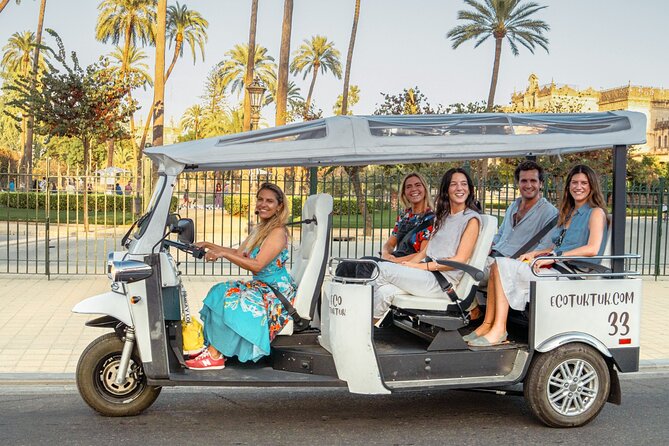
Eco tuk tuk keeps Seville fun. I love the comfortable private ride plus the fixed photo stops that help you get great angles without turning the trip into a scavenger hunt. One heads-up: this tour is heavy on landmark viewing (including repurposed Expo-area spots), so if you want museum-depth, you may leave wanting more.
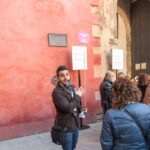
This is a straightforward, sights-first way to see a lot in a short time. You’ll cover neighborhoods and major buildings while a guide (I’ve had great ones like Karen, Juan, and Miguel on similar departures) helps you connect the dots fast, especially when you first arrive. It runs in heat and rain, with winter protective layers and blankets on the tuk tuks, so you’re not stuck shivering the whole time.
In This Review
- Key highlights before you go
- Why this eco tuk tuk format works in Seville
- Triana and the Triana Bridge: food streets and ceramic shops
- San Telmo Palace and the Royal Tobacco Factory: grand buildings, built for a purpose
- Plaza de España and María Luisa Park: the postcard stop that still makes sense
- Torre del Oro and Maestranza: river power and Seville’s arena tradition
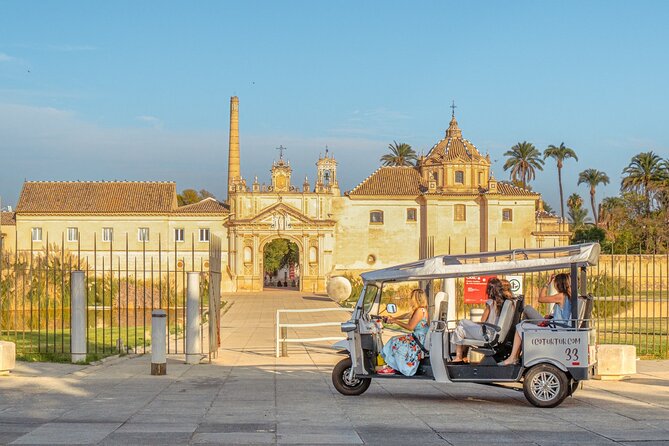
- Monasterio de la Cartuja and Isla de la Cartuja: calm monastery energy meets 1992 vision
- Basilica de la Macarena: a gentle, local finale in Casco Antiguo
- Price, comfort, and whether it’s good value
- Who this tour suits best (and who should choose differently)
- Should you book the private eco tuk tuk tour of Seville?
- FAQ
- How long is the eco tuk tuk tour?
- Where do I meet for the tour?
- Is this a private tour?
- How many people can ride in one tuk tuk?
- What’s included in the price?
- Are entrance tickets included?
- Will there be photo stops?
- Does the tour run in bad weather?
- Are tips included?
- Can babies or pets join?
Key highlights before you go
- Private eco tuk tuk comfort for your group, with drivers who help you get on (useful if you’re traveling with seniors)
- Photo stops are scheduled at pre-established places, so you can actually plan your timing
- Triana + the river views right after the Isabel II (Triana) Bridge gives you an easy food-and-crafts vibe
- Plaza de España and María Luisa Park for that classic Seville architecture moment (and Plaza de España is free)
- Expo-era Seville meets everyday life at Isla de la Cartuja and nearby landmarks around 1992-style sights
- A solid mix of exteriors from the Royal Tobacco Factory to the Torre del Oro and the Maestranza bullring
Why this eco tuk tuk format works in Seville
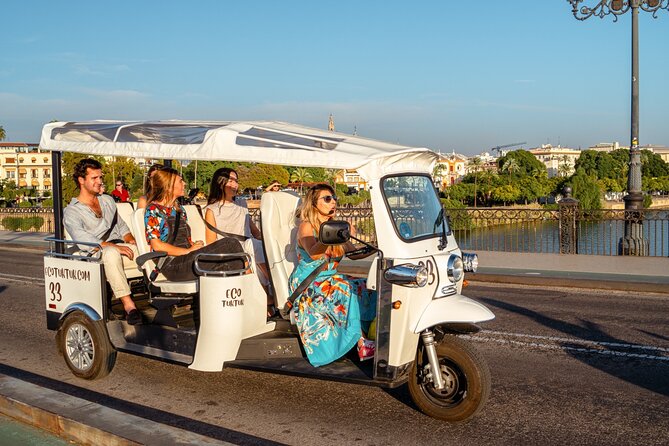
Seville is one of those cities where the sidewalks can be deceptively tricky: pretty, but long walks add up quickly—especially in the afternoon heat. A tuk tuk solves that problem with a low-effort rhythm. In 1 to 2 hours, you can hit big visual targets without spending your whole trip figuring out routes, parking, or where to stand for photos.
The private setup matters too. Your tuk tuk is booked for your group, and the schedule is built around the drive-plus-photo-stop style. That means you’re not waiting around for other people to catch up, and you’re less likely to feel rushed as you move between neighborhoods.
And because this tour uses pre-planned stops, you avoid the common self-guided problem: you arrive at a spot, realize you chose the wrong angle, and then lose 20 minutes trying to fix it. Here, the stops are locked in. That can be a drawback if you’re hoping to customize everything, but it’s a big plus if you just want the highlights done well.
You can also read our reviews of more private tours in Seville

Triana and the Triana Bridge: food streets and ceramic shops
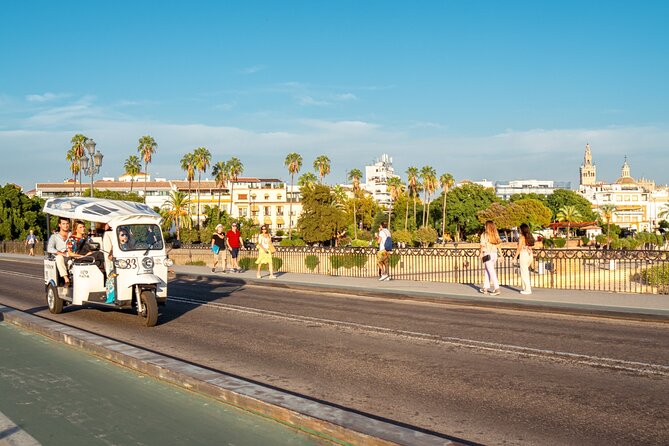
The tour starts by crossing the Guadalquivir River at the Isabel II Bridge, often called the Triana Bridge. This is a smart first move. You get instant perspective on where the action sits, and you’re already oriented toward Triana, one of Seville’s most lively neighborhoods.
In Triana, you’ll focus on the market area near the bridge. The vibe is simple and local: you’ll see stalls and small places where classics like salmorejo and croquettes show up, plus other tapas options that feel tied to daily life rather than tourist performance. If you’re a foodie, this is the sort of stop that helps you understand what people mean when they talk about Seville eating culture.
Keep an eye on Calle Betis, along the river. It’s where you’ll find more restaurants and bars, and it’s also near flamenco tablaos. And around the Centro Cerámica Triana museum area, you’ll spot craft shops selling traditional ceramics. Even if you don’t buy anything, it’s a great way to connect Seville’s artwork traditions to real neighborhoods, not just souvenir stands.
A practical note: this portion is short. Think quick orientation and photos, not a food crawl. If you want to eat, treat the Triana stop as a “mark this area for later” moment.
San Telmo Palace and the Royal Tobacco Factory: grand buildings, built for a purpose
After Triana, you’ll roll past the Palace of San Telmo, also known as the seat of the Presidency of the Junta de Andalucía. It’s Baroque and was built between the 17th and 18th centuries to serve as the headquarters of a sailors’ college. That detail changes how you look at the building. You’re not just seeing a pretty facade; you’re seeing a structure designed for training and authority.
Next comes the Royal Tobacco Factory of Seville, one of the big industrial landmarks from the 18th century. The key facts worth remembering are these: it was the headquarters of the first tobacco factory established in Europe, and it’s considered the most important industrial building in Spain from that era. It’s also protected as a Cultural Interest asset (a Historical Monument).
Why this stop is valuable, even if you don’t go inside: it shows you Seville as more than churches and courtyards. You see how power and industry shaped the city, and that helps later when you reach places like Plaza de España and the river towers.
If you’re the type who loves stepping into interiors, plan to add separate time later. The tour indicates admissions are not included here, so you’re mainly seeing this part from outside during the scheduled stop.
Plaza de España and María Luisa Park: the postcard stop that still makes sense
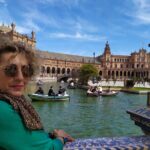
If you’ve seen photos of Seville, you’ve probably seen Plaza de España. The good news is: it earns its fame for real. You’ll spend a short stop here inside María Luisa Park, which is Seville’s first urban park and one of its green lungs. In 1983 it was declared an Asset of Cultural Interest as a Historic Garden, and it was inaugurated on April 18, 1914.
The plaza itself was designed by Aníbal González and built between 1914 and 1929 for the Ibero-American Exposition of 1929. That matters because it explains why the architecture feels so theatrical and intentional—this wasn’t built gradually over centuries. It was created for a specific showcase moment, and it still reads like that.
Plaza de España also has a practical perk: the tour lists admission as free. That doesn’t guarantee you’ll be going inside anything, but it removes one common cost barrier when you want to wander a little on your own while you’re there.
Also on the route is the Plaza de América inside the park, framed by nearby cultural buildings, including the Museum of Popular Arts and Customs to the north, the Archaeological Museum to the south, and the Royal Pavilion to the east. Even from the outside, the area helps you grasp how Seville organizes major sights into connected zones.
What to do during a short stop: pick one grand view, then walk just enough to change your angle. Don’t try to cover every corner in five minutes. The goal is to leave with two or three photos you actually love, plus a mental map for later exploring.
Torre del Oro and Maestranza: river power and Seville’s arena tradition
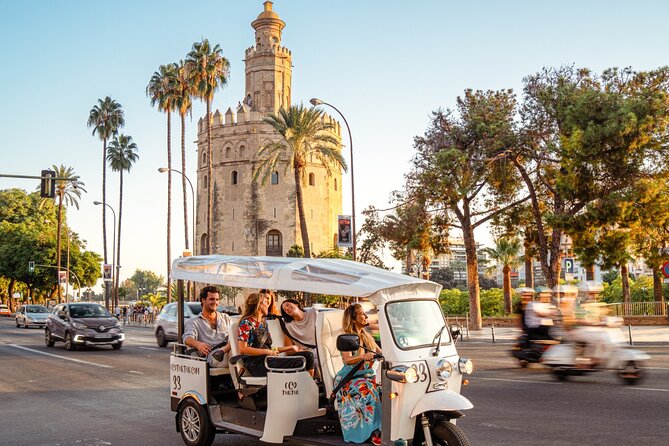
Next up is Torre del Oro, the watchtower on the left bank of the Guadalquivir River. It’s a compact but memorable stop because it ties the city’s river history together. The tower dates back to 1221, stands 36 meters tall, and is formed by three bodies.
It’s the kind of sight where the visuals make sense fast: watchtower function, river traffic, and the defensive needs of a port city. Even if you don’t know the dates by heart, the structure’s shape tells the story.
Then you’ll pass Plaza de Toros de la Maestranza in the Arenal neighborhood. It was built in the 18th century and is owned by the Real Maestranza de Caballería de Sevilla. If you’re curious about Seville’s traditions, this arena is one of the most recognizable places linked to those cultural rhythms.
Again, the tour style here is seeing and photographing, not a deep stop for ticketed entry. The itinerary notes admissions are not included, so if you want an official interior visit, you’ll need separate planning.

Monasterio de la Cartuja and Isla de la Cartuja: calm monastery energy meets 1992 vision
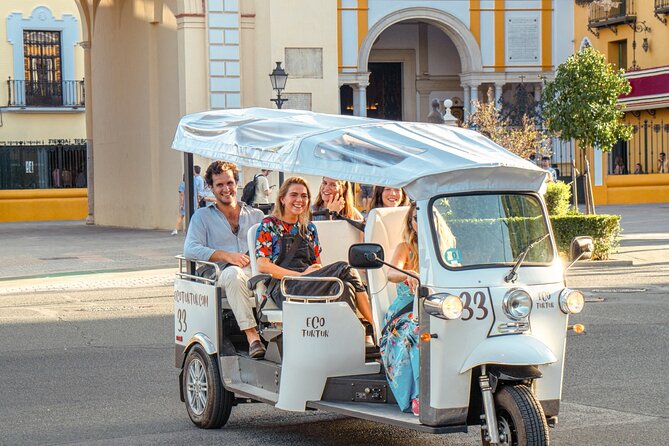
One reason the longer option is worth considering is the stop at Monasterio de la Cartuja and then Isla de la Cartuja. The monastery, also called Santa María de las Cuevas, sits on the island of La Cartuja and is one of the four Carthusian monasteries in Andalusia.
This is the part where your mood can shift. With the monastery, you get quieter, more contemplative energy, plus a sense of how religious life shaped the city’s geography—monasteries often anchor a place, not just a building.
Then the tour moves to Isla de la Cartuja, which is described as a cultural and avant-garde space for leisure, entertainment, and art. If you’ve ever felt like Seville can’t decide whether it’s ancient or modern, this is a good resolution. You’re still in the same river-land feel, but the purpose changes.
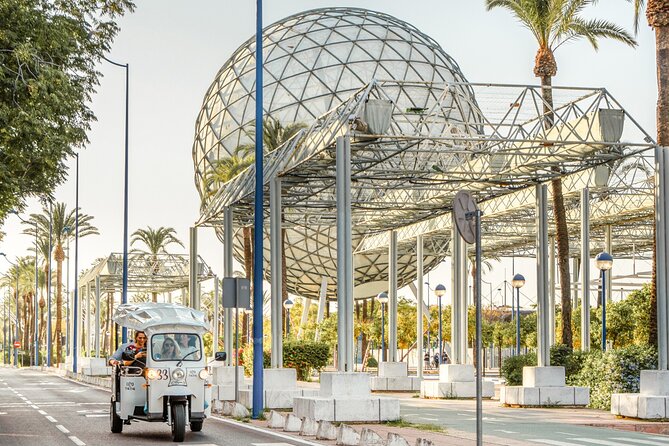
A specific icon you’ll see referenced is the bioclimatic sphere on Marie Curie street, tied to the Universal Exposition of Seville in 1992. That’s a fun detail because it turns the area into something you can actually name and place in your memory: not just modern buildings, but a specific Expo-era landmark.
This is also the spot where the format can frustrate people who want “culture” in the museum sense. One review called out disappointment with more Expo-area architecture and less cultural depth. I’d take that as an expectation check: this is a highlights tour with architectural and neighborhood stops. It’s not designed to replace museum time.
Still, if you like variety—monastery calm followed by modern cultural spaces—it’s a strong pairing.
Basilica de la Macarena: a gentle, local finale in Casco Antiguo
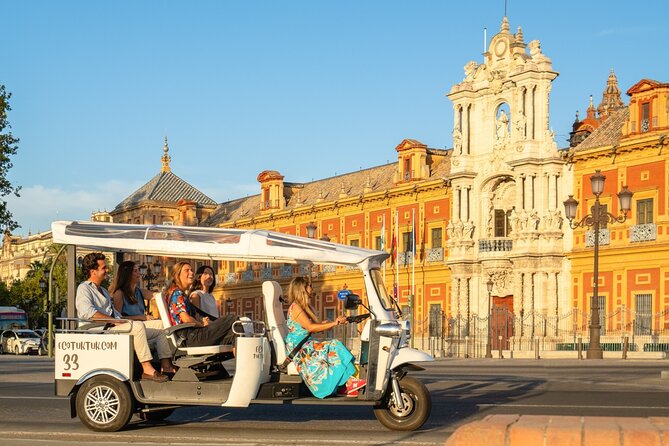
The last stop is Basilica de la Macarena, a Catholic temple at number 1 Calle Bécquer in the San Gil neighborhood, within the Casco Antiguo district. This one tends to feel more grounded because it’s tied to a neighborhood identity rather than a major Expo or river landmark.
The tour notes this stop as short, with admissions not included. So plan for exterior viewing and photos. But even within a quick stop, a basilica can give you that last Seville fix: the spiritual details, the scale, the neighborhood texture.
If you’re ending your day and energy is running low, this is a good cap. You don’t have to sprint for one more big viewpoint, and you finish with a place that feels lived-in.
Price, comfort, and whether it’s good value
The price is $80.23 per person, and it’s often booked about 26 days in advance. That’s not cheap-cheap, but it can be good value if you care about comfort and time.
Here’s how I think about the value:
- You’re paying for a guide plus a private transport method that saves energy and helps you hit multiple areas efficiently.
- You get a set itinerary with photo stops planned for you. That reduces decision fatigue.
- You’re not stuck doing multiple transit hops, and you don’t lose time searching for the best angles.
The private-tuk-tuk setup also affects value. Tuk tuks are booked privately, with a legal max of 4 passengers per tuk tuk. If you’re traveling as a couple, your per-person cost stays clear. If you’re traveling as a group, you may need more than one tuk tuk, and that can change the overall feel of the deal.
This is also a strong choice for people who want a guided “first look” at Seville. The stops are the kind you can later build around with longer visits on your own.
Who this tour suits best (and who should choose differently)
This tour is ideal if you want:
- a quick overview of Seville’s biggest visual hits without wearing yourself out,
- help from a guide who can add context fast (and the guides named in feedback—Karen, Juan, Miguel—show the level you can get),
- scheduled photo stops that take the guesswork out of where to stand.
It’s less ideal if you want:
- a museum-heavy day or a deep dive into single sites,
- an itinerary you can rearrange on the fly,
- lots of ticketed interior time.
The format is fixed: tours cannot be modified, and photo stops can’t be changed. Street closures and demonstrations can shift timing, and in that case your route may adjust. The activity can also be canceled if delays exceed 15 minutes, and in case of customer delay the trip may be reduced based on time lost.
That’s normal for short, tightly planned sightseeing. Just know what you’re buying: a guided highlight run with great logistics.
Should you book the private eco tuk tuk tour of Seville?
I’d book it if you want a first-day win. It’s comfortable, private, and designed to get you oriented fast—especially with the Triana Bridge to Plaza de España to Cartuja area flow. The combination of river views, landmark architecture, and that Expo-era modern contrast can make Seville feel bigger than you expected.
I wouldn’t book it as your only plan if your top priority is deep cultural immersion inside museums or specific historic sites. For that, you’d pair this with at least one longer, ticketed block on your own.
If you do book, choose the 120-minute option when you can. It adds Isla de la Cartuja, which gives you the extra modern/1992 reference point and a nicer full-circle mix of Seville moods.
FAQ
How long is the eco tuk tuk tour?
The tour runs about 1 to 2 hours. On a 60-minute tour, a stop is made at Plaza de España. On the 120-minute tour, a stop is also made at Isla de la Cartuja.
Where do I meet for the tour?
You start at Parking APK2 ArjonaPuente del Cristo de la Expiración, 746, Casco Antiguo, 41001 Sevilla, Spain, and the tour ends back at the meeting point.
Is this a private tour?
Yes. Only your group participates.
How many people can ride in one tuk tuk?
Tuk tuks are booked based on group needs, with a legal maximum of 4 passengers per tuk tuk.
What’s included in the price?
An accompanying guide is included.
Are entrance tickets included?
Plaza de España is free. For other stops, admission tickets are listed as not included.
Will there be photo stops?
Yes. The tour makes pre-established photo stops at fixed locations, and the stops can’t be modified.
Does the tour run in bad weather?
The tours take place in rain or heat. In winter, tuk tuks have protective layers against rain and wind, plus blankets to keep you warm. Cancellation is only under extreme conditions.
Are tips included?
No. Tips are not included.
Can babies or pets join?
The minimum age is two years, and babies are not allowed. Pets and companion animals are not allowed.