REVIEW · SEVILLE
Private Half Day Walking Tour of Seville
Book on Viator →Operated by Tours in Sevilla, Don Carlos · Bookable on Viator
Seville’s best stories hide in plain sight. This private half-day walking tour strings together gates, mosques turned churches, and royal power across Seville, with guides who know how to make history feel human. I especially love the smart route through major landmarks without wasting time, and I love the way guides like Carlos and Fernando bring the places alive with humor and clear explanations.
One possible drawback: you’re on foot for the full stretch, and the itinerary expects moderate fitness (think comfy shoes and an eye on shade).
In This Review
- Key things to look for on this Seville walking tour
- A Seville walk that links Islamic roots to America’s archives
- Starting at Puerta de Jerez: a gateway to 1929, and to the city’s layers
- Old Royal Tobacco Factory: Seville’s power plant, now the University rectorate
- Palacio de San Telmo and the navigator-school idea
- Torre del Oro: Islamic architecture and maritime traffic in one view
- Postigo Arch and the Royal Shipyards: where America starts to feel real
- Plaza del Cabildo: a small square with a big reason to exist
- Seville Cathedral and the Giralda: one building’s identity transformation
- The General Archive of the Indies: the paperwork behind empire
- Real Alcázar: royal power today, and Dorne from Game of Thrones
- Barrio de Santa Cruz: the old Jewish quarter, patios, and opera settings
- Giralda and the city’s government center: Renaissance Seville under Carlos V
- Church of El Salvador and the old medina idea
- Plaza de la Encarnación and the mushrooms: modern Seville beside old streets
- Calle Sierpes: shops, cafés, and Cervantes as a prisoner
- Finishing at Plaza de San Francisco: easy access to more Seville
- Price and value for a 2–3 hour private guide in Seville
- Who should book this walking tour?
- Should you book this Private Half Day Walking Tour of Seville?
- FAQ
- How long is the Private Half Day Walking Tour of Seville?
- Where does the tour start and where does it end?
- Is this tour private?
- What language is the tour offered in?
- What’s included in the price?
- Is transportation included?
- Is the tour mostly outdoors?
- What happens if the weather is bad?
- Do you need to book in advance?
Key things to look for on this Seville walking tour
- A clean loop of landmark exteriors that still feels like real storytelling, not just photo stops
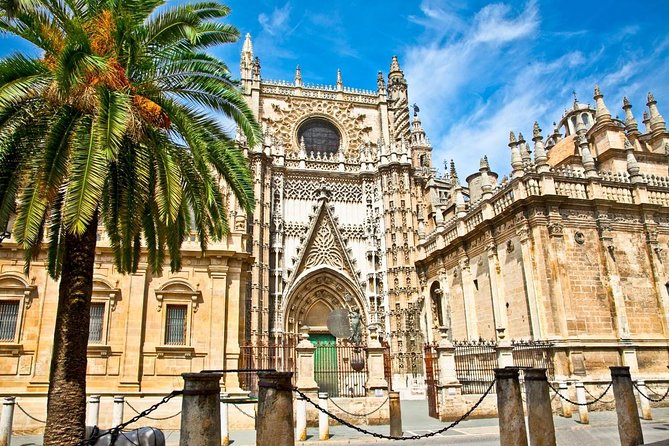
- Seville Cathedral + the Giralda explained as one transformed identity, from mosque to Christian landmark
- UNESCO Archivo de Indias with the focus on what’s inside: documents, maps, and Columbus links
- Real Alcázar walls and the Dorne filming reference, a fun pop-culture layer on top of royal history
- Metrosol Parasol (Setas de Sevilla) by Jürgen Mayer, a modern counterpoint to the old streets
- Calle Sierpes and Cervantes’ Royal Prison connection, tied to walking through the commercial center
A Seville walk that links Islamic roots to America’s archives
This tour is built like a story with chapters. You start near Puerta de Jerez and move through Seville’s key eras—Al-Andalus influences, Catholic power, the city’s maritime reach, and the paperwork that came out of the age of exploration. Even though much of what you see is from the outside, the guide’s job is to point your eyes in the right places so you understand why these buildings matter.
You’ll also get a big advantage from the format: it’s private, so it’s only your group. That usually means fewer delays, easier questions, and a route that makes sense for your pace—especially useful when Seville gets hot.
If you’re short on time but want the “how did Seville become Seville?” answer, this tour gives it to you fast.
You can also read our reviews of more walking tours in Seville

Starting at Puerta de Jerez: a gateway to 1929, and to the city’s layers
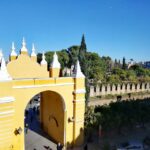
You begin at Puerta de Jerez, one of Seville’s old city gates. The area is a great first lesson because it shows how Seville constantly reuses and repurposes space—old defensive structure ideas right next to later prestige buildings.
From there, you’ll look at Hotel Alfonso XIII, built for the Ibero-American Exposition of 1929. It’s the kind of stop that could feel random on a standard route, but it’s actually smart. It tells you Seville didn’t just grow slowly over centuries; it also staged major moments where the city showcased itself to the world.
In the same plaza area, you’ll spot other landmark exteriors, including Palacio de San Telmo and the old Tobacco Factory (more on that next). This “jump” from 1929 back to earlier Seville helps you avoid the common mistake of treating the city’s history like separate unrelated museums.
Old Royal Tobacco Factory: Seville’s power plant, now the University rectorate

Next up is the old Royal Tobacco Factory of Seville, a building that the guide will frame as massive and influential. The structure is described as the largest in Spain after the Escorial, and today it serves as the Rectorate of the University of Seville.
There’s also a cultural hook you’ll likely enjoy: this tobacco factory is the setting of Bizet’s Carmen. Even if you don’t know the opera scene by scene, hearing the connection to the real building changes how you read the walls and windows. It becomes less of a “historic facade” and more of a working machine that once shaped daily life.
A practical note: since this is an exterior-focused stop, you’ll get more out of it if you keep your attention on lines, scale, and how the building sits in its surroundings.
Palacio de San Telmo and the navigator-school idea
Then you’ll look at the Palacio de San Telmo exterior. This stop connects Seville to the Age of Discovery in a direct way: it originally functioned as a school for navigators, then later became tied to the Spanish royal family.
And it pays off later, too. The garden associated with San Telmo links to María Luisa Park, the site of the Ibero-American Exposition of 1929. So you get the same 1929 thread again, but this time it’s not just about a single hotel—it’s about how the city’s big public spaces grew around major historical moments.
If you like your tours to explain why things exist—not just what they are—this stop does that.
Torre del Oro: Islamic architecture and maritime traffic in one view
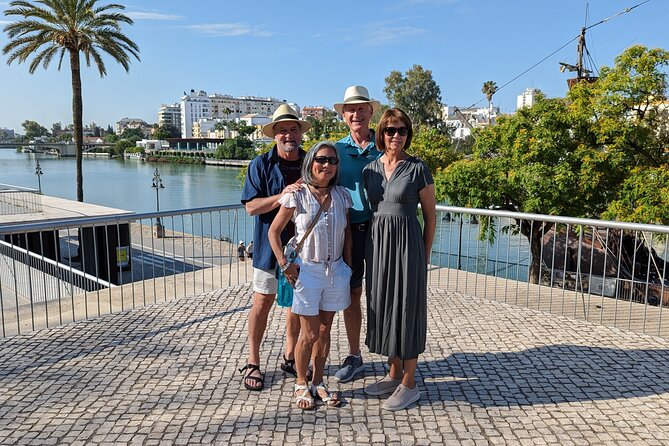
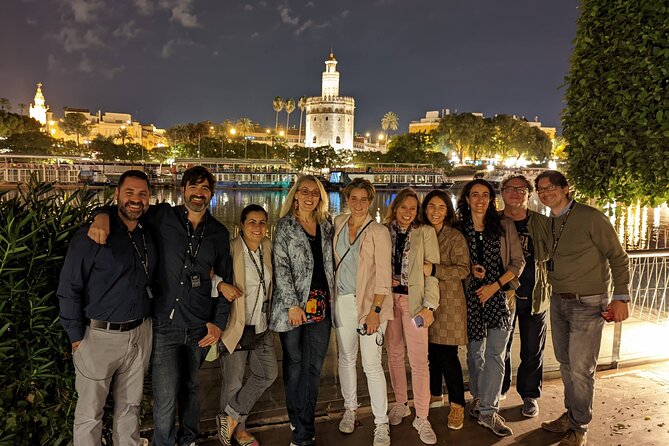
As you keep walking, you’ll see Torre del Oro from the outside. It’s described as a 13th-century example of Islamic architecture, with historic importance tied to Seville’s maritime traffic.
This is a stop where the guide’s interpretation matters. Towers like this weren’t decorative. They helped control, signal, and support the movement of goods and people. You’ll probably come away thinking about Seville less as a pretty city and more as a port city whose skyline was functional.
You can also read our reviews of more private tours in Seville





Postigo Arch and the Royal Shipyards: where America starts to feel real
Next is the Postigo Arch, one of the old gates still preserved. From here, you also see exteriors connected to the Royal Shipyards—the place where ships for voyages to America were built.
This is where pop culture sneaks in without taking over. The shipyards are noted for filming used in Game of Thrones, so the guide may point out filming relevance alongside the real historical context of shipbuilding and empire logistics.
Even if you’re not into that series, this stop helps you understand Seville’s global role. You’re literally walking past the physical infrastructure behind faraway stories.
Plaza del Cabildo: a small square with a big reason to exist
You’ll reach Plaza del Cabildo, described as one of Seville’s most beautiful and special squares. The guide will connect it to the Cathedral of Seville’s canons being kept there, plus an antiques market held on Sundays.
This square is a good example of why walking tours beat quick transit. On the map, Plaza del Cabildo is just a point. On foot, you feel how it slots into the city’s movement—how people gather here, not because it’s flashy, but because it’s useful and charming in everyday life.
If your ideal trip includes a bit of realism—like a place where commerce and history share space—this stop is worth it.
Seville Cathedral and the Giralda: one building’s identity transformation
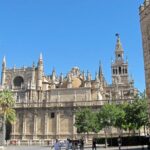
Now you approach one of the main reasons people come to Seville: the exteriors of the Cathedral of Seville, described as the largest Gothic temple in the world and a UNESCO World Heritage Site since 1987. The guide will also explain the fusion of styles: the Christian Gothic cathedral sits on a site with an Islamic past, when the area was the main mosque of Seville.
That’s the key idea to listen for. The cathedral isn’t just Gothic as a style choice—it’s Gothic as the end result of changing power, faith, and city planning. When the guide points out connections to that earlier mosque, the whole cathedral complex starts making sense as one evolving place rather than two separate time periods.
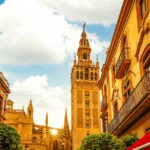
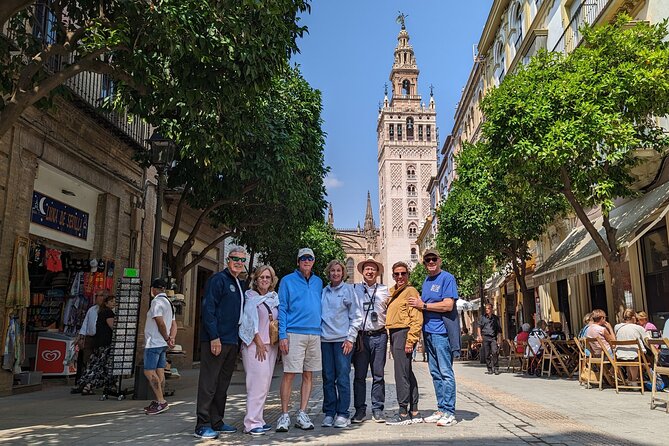
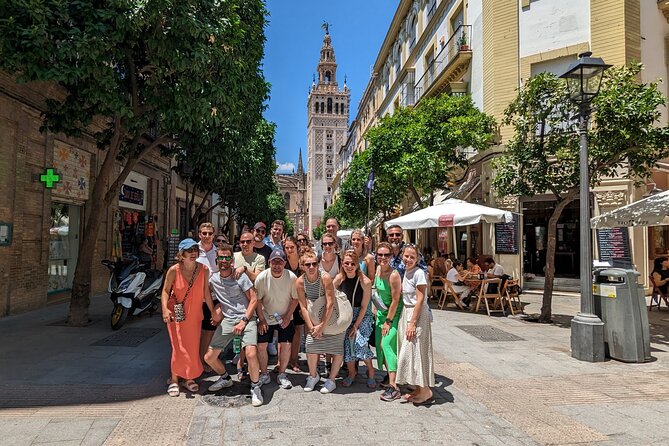
And then, of course: the Giralda tower. You’ll see it from the outside as Seville’s iconic bell tower symbol. The guide will frame it as a 12th-century Islamic architecture example that became a Christian bell tower when the cathedral took over the mosque site.
If you’re the type who wants one photo that actually means something, put your attention on the Giralda.
The General Archive of the Indies: the paperwork behind empire
You’ll also see the exteriors of the General Archive of the Indies. This is another UNESCO site tied to Seville’s global role. The tour description emphasizes that it houses more than 40,000 documents related to America, plus maps, the Treaty of Tordesillas, and autograph texts of Christopher Columbus.
That’s the practical benefit of this stop. It changes the way you think about exploration. People picture ships and battles. This stop reminds you that empires ran on records: claims, voyages, legal documents, and geographic data.
Since the tour focuses on exteriors, you won’t be touring reading rooms here. But you should still get something useful: a mental connection between the city’s ports and the archive’s shelves.
Real Alcázar: royal power today, and Dorne from Game of Thrones
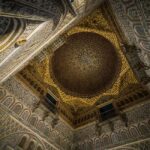
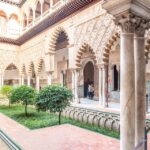
You’ll see the Real Alcázar exteriors next, introduced as a World Heritage Site and described as the oldest royal palace in Europe still in use. The guide will talk through stories about the kings who lived there and point out the palace’s character through its walls and visible features.
There’s also a modern reference you may appreciate: the tour connects the palace to Dorne, one of the seven kingdoms in Game of Thrones, filmed in the Alcázar.
This matters for two types of travelers:
- If you’re a TV fan, it gives you a reason to stop and look closely instead of just moving on.
- If you’re not, it still works because the guide uses the filming reference as a bridge to how the palace’s setting feels—sunlight, courtyards, and the “royal” sense of space.
The only caution: filming references can sometimes steal attention. The good guide keeps it as a fun add-on, not the whole story.
Barrio de Santa Cruz: the old Jewish quarter, patios, and opera settings
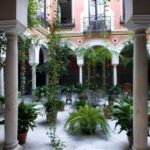
After the big-ticket monuments, you move into a more intimate Seville. You’ll walk through Barrio de Santa Cruz, described as the old Jewish Quarter and one of the city’s most picturesque areas, full of charming squares, alleys, and patios.
The guide is likely to steer you toward specific squares—Doña Elvira, Los Venerables, Agua y Vida, and Plaza de Santa Cruz—so you don’t just stroll randomly. One of the benefits of a guided walk is that it prevents you from missing the “why here?” details.
There’s also an opera angle: the neighborhood connects to performances such as The Barber of Seville. That’s a neat way to blend culture with street-level exploring, especially if you like learning how art borrows real locations.
If you’re thinking about shopping and coffee breaks, this is where you’ll naturally slow down. And because it’s walking through streets, you’ll be able to choose what to explore on your own after the tour ends.
Giralda and the city’s government center: Renaissance Seville under Carlos V
Back near the center, the tour includes the outside of the Seville City Hall, built in the 16th century during the reign of Emperor Carlos V. It’s described as a wonderful example of Renaissance architecture in Seville, and the guide will likely connect it to Seville’s prosperity during the era when the city served as the port and gateway to America.
This stop is useful because it explains how wealth showed up in brick and stone. You’re not just seeing a church and a tower—you’re seeing how money turned into civic buildings, too.
If you tend to over-focus on religious landmarks, this is a good balancing stop.
Church of El Salvador and the old medina idea
Another exterior stop that has a lot of meaning is the Church of El Salvador. The tour describes it as originally the first mosque in Seville in the 9th century, later transformed into a collegiate church in the 13th century during the time of Fernando III el Santo.
The guide will also point out that the church is surrounded by shops, matching the logic of the old medina where the mosque sat in a commercial center. It also notes that an old ablution courtyard is preserved.
This is one of those “you can’t unsee it once you understand it” moments. If you’ve only experienced Seville as postcards, this stop ties the present street life to the city’s earlier urban design.
Plaza de la Encarnación and the mushrooms: modern Seville beside old streets
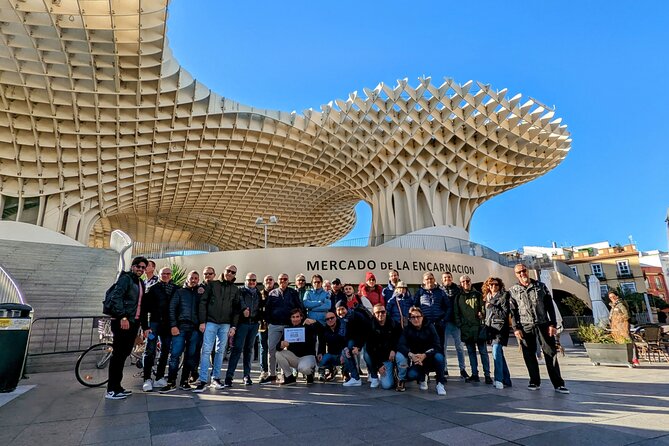
Next you’ll arrive at Plaza de la Encarnación to see the famous mushrooms of Seville, also called Metrosol Parasol or Setas de Sevilla. The tour description specifies the project is by German architect Jürgen Mayer, and the structure is framed as one of Seville’s major tourist attractions.
Why this belongs in a walking tour that also covers mosques and Gothic towers: it shows how Seville keeps updating itself. This isn’t a return to the past. It’s Seville saying, yes, we respect history, but we still build for today.
When you stand there, look at how the new structure changes pedestrian flow in the square. That’s part of the story too.
Calle Sierpes: shops, cafés, and Cervantes as a prisoner
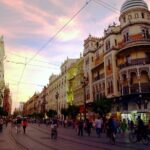
You’ll walk down Calle Sierpes, described as one of Seville’s best known streets, full of shops and famous cafés. It’s also where you’ll see the old Royal Prison, noted as the place where Miguel de Cervantes was a prisoner.
This stop is a smart reset. After heavy monuments and archives, you get back to a street you could easily pass by quickly. The guide turns it into a narrative: a commercial street built over older institutional functions.
If you want to keep learning after the tour, this street gives you an easy path to do it: pop into shops, grab a drink, or just keep walking.
Finishing at Plaza de San Francisco: easy access to more Seville
You finish at Plaza de San Francisco, near the town hall and close to the Cathedral area. The advantage of ending here is simple: you can keep wandering right away without needing a complicated plan.
It also means the tour ends where Seville’s central sights cluster, so you’re not cutting yourself off from the rest of the city.
Price and value for a 2–3 hour private guide in Seville
At $133.03 per person for about 2 to 3 hours, this isn’t the cheapest way to see Seville. But it can be good value if you care about more than landmarks.
Here’s why the price can make sense:
- You’re getting a professional guide described as having 30 years of experience.
- It’s private, so you’re not competing with other groups for time and attention.
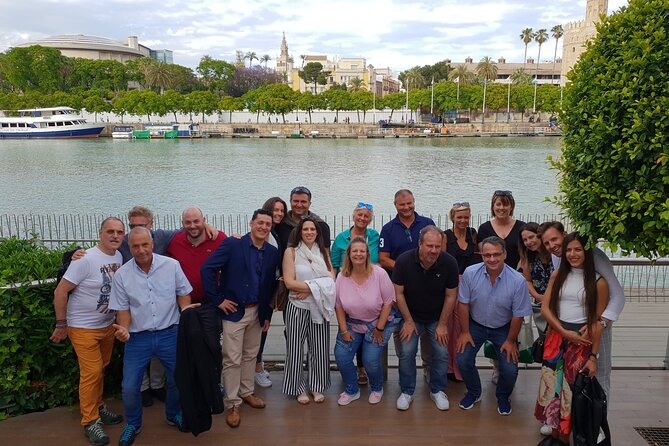
- You get tour photos included, which is helpful when Seville’s light and street angles can be tricky on your own.
- There’s no private transportation included, which keeps the tour simple and walkable, but it also means you’re paying for guiding rather than car time.
For families or small groups, a guided route often saves you the hassle of figuring out what to see first. If you try to do this kind of loop solo, you’ll spend time looking up details mid-walk—and that’s time you could spend soaking up the places.
Who should book this walking tour?
This is a strong choice if you:
- Want a short Seville plan that connects major sites instead of listing them
- Like your history told through real streets and buildings
- Enjoy cultural tie-ins like Carmen, Cervantes, and Game of Thrones references
- Prefer a private format where the guide can keep your group together
It may be less ideal if you:
- Want lots of interior visits, because the itinerary emphasizes exteriors and walking
- Have mobility limits, since the tour expects moderate fitness and is entirely on foot
If your top goal is understanding the city quickly and then choosing your own follow-ups, this works well.
Should you book this Private Half Day Walking Tour of Seville?
Yes—if you want an efficient, guided route through Seville’s key identity changes (mosque to cathedral, port to archive, palace to storytelling set) in just a few hours. The value comes from how the guide connects the stops so you don’t leave with a bunch of disconnected photos.
If you’re expecting tons of indoor access or a bus-and-stop day, adjust your expectations. But for a walking tour that helps you read Seville—and not just see it—this one is a solid bet.
FAQ
How long is the Private Half Day Walking Tour of Seville?
The tour lasts about 2 to 3 hours.
Where does the tour start and where does it end?
It starts at Puerta de Jerez and ends at Plaza de San Francisco.
Is this tour private?
Yes. It’s a private tour/activity, and only your group participates.
What language is the tour offered in?
The tour is offered in English.
What’s included in the price?
Included are an official professional guide of Seville (with 30 years of experience) and tour photos.
Is transportation included?
No. Private transportation is not included.
Is the tour mostly outdoors?
The itinerary specifies seeing exteriors of major sites and includes walking through neighborhoods and streets.
What happens if the weather is bad?
This experience requires good weather. If it’s canceled due to poor weather, you’ll be offered a different date or a full refund.
Do you need to book in advance?
You’ll receive confirmation at booking, and the experience is typically booked well in advance based on demand.