REVIEW · SEVILLE
Express Tour of Seville in Private Eco Tuk Tuk
Book on Viator →Operated by Eco Tuk Tuk - Spain · Bookable on Viator
Seville looks good from a tuk-tuk. This private eco ride strings together some of the city’s most photo-friendly landmarks, with fixed breaks designed for seeing (and shooting) the best angles. I also like the fact that the guide experience can be truly personal, with multilingual, high-energy storytelling from drivers such as Juan and Hugo.
One important consideration: each tuk-tuk is capped at 4 passengers. If you have a bigger group, you may need two tuk-tuks, and the price per person can rise compared with what you’d expect for a small party.
In This Review
- What You’ll Actually Love About This Private Tuk-Tuk Ride
- A Fast, Photo-Focused Overview of Seville’s Big Sights
- Triana Bridge and the Guadalquivir: Where the City’s Story Starts
- Triana Neighborhood: Tapas Lanes, Craft Shops, and River Views
- San Telmo and the Royal Tobacco Factory: Baroque Power and Industrial Scale
- Plaza de España and María Luisa Park: Seville at Postcard Best
- Plaza de América, Torre del Oro, and the Maestranza Bullring
- Price, Comfort, and Small-Group Logistics in Private Eco Tuk-Tuks
- Should You Book This Express Tour of Seville in a Private Eco Tuk Tuk?
- FAQ
- How long is the Express Tour of Seville in a Private Eco Tuk Tuk?
- Is the tour private or shared?
- Where does the tour start and end?
- Can I change the route or the photo stops?
- How many people can ride in each tuk-tuk?
- Are babies or young children allowed?
- What happens if it rains, or if I need to cancel?
What You’ll Actually Love About This Private Tuk-Tuk Ride
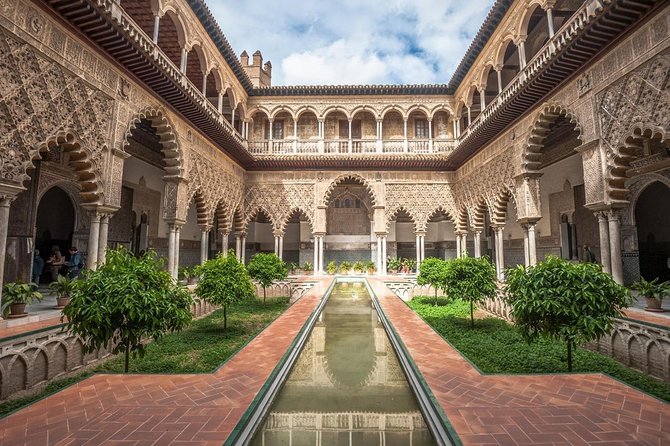
- 60 minutes that feel like a shortcut: you get a fast orientation without spending the whole day walking
- Photo stops are built in: especially at Plaza de España (and additional photo time on the longer option)
- Triana + the Guadalquivir in one loop: you see the neighborhoods and the river connection right away
- Classic Seville variety: Baroque architecture, an enormous historic industrial site, and major scenic squares
- Comfort-minded private transport: drivers assist with getting on, and the vehicle is suitable for seniors
A Fast, Photo-Focused Overview of Seville’s Big Sights
If you only have a day (or two) in Seville, you need a way to get your bearings fast. This express format is built for that. You’ll move efficiently across neighborhoods and viewpoints, with a guide talking you through what you’re seeing while you stay seated and out of the heat (or rain).
The big win is how the tour is structured around sightlines. Instead of rushing past everything, you get short, pre-set moments to stop and take photos. For many visitors, that means you don’t end up hunting for the perfect view on your own later.
You’ll also benefit from the private setup. It’s only your group, so if you need a little more time at a spot to frame a shot or understand a detail, your driver can usually work with the flow—within the fixed route. Just remember, the stops themselves are not designed to be changed on the fly.
You can also read our reviews of more private tours in Seville


Triana Bridge and the Guadalquivir: Where the City’s Story Starts
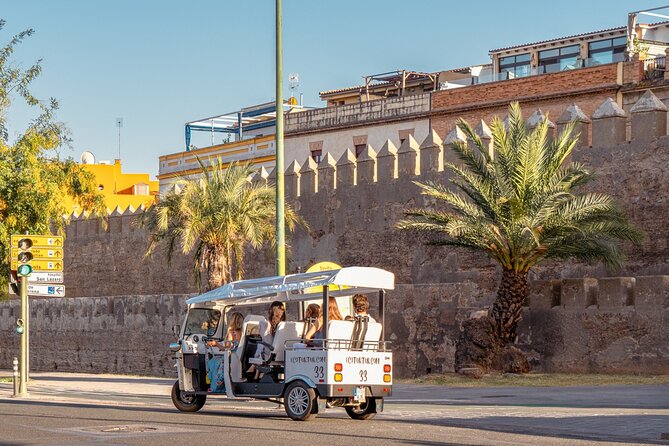
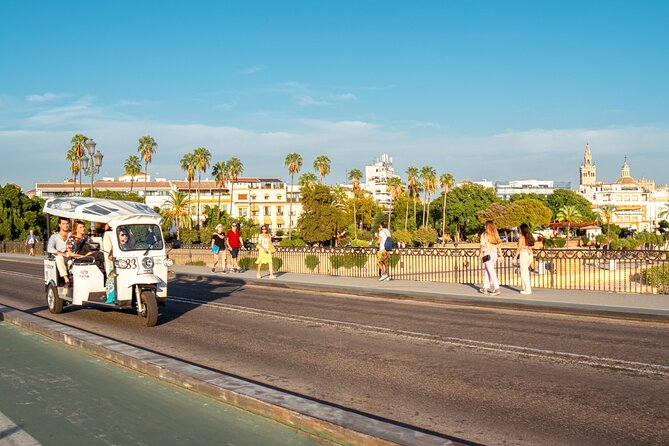
You kick things off near the Triana area, starting at a meeting point in the historic core (Casco Antiguo). From there, your first scenic anchor is the Isabel II Bridge, also called the Triana Bridge, spanning the Guadalquivir River.
This matters because Seville’s layout makes more sense once you connect the river to the neighborhoods. The bridge is like a mental map marker: one side pulls you toward the city center, the other toward Triana’s distinct vibe. Even if you’ve read about Seville, seeing the river channel and the bridge position early helps everything later feel less random.
It’s also a practical first move for photos. The river creates natural depth and framing, and a tuk-tuk lets you get into the right visual angle without threading through foot traffic.
Triana Neighborhood: Tapas Lanes, Craft Shops, and River Views

Once you’re over the bridge, you enter Triana—a neighborhood known for everyday life and food culture. You’ll get the sense of Triana’s rhythm quickly, especially around the market area near the river.
This stop is where Seville turns from landmark sightseeing into local atmosphere. You’ll pass the kinds of places you’ll actually want to return to later: stalls and small eateries where classics like salmorejo and croquettes show up, and where you can graze your way through tapas culture.
Triana also has a crafts-and-culture side. Around the Centro Cerámica Triana area, shops often showcase ceramic work, which is one of those Seville souvenirs that feels connected to place rather than just mass-produced.
If you’re the type of visitor who likes to understand the city’s neighborhoods—not only its monuments—Triana is the stop that gives you that context. The only catch is time: these are short breaks, so you’ll be learning more than consuming. Treat it as a first look, then plan a longer wander later if you want.
San Telmo and the Royal Tobacco Factory: Baroque Power and Industrial Scale
As you continue, the tour shifts from streets and food to major architecture.
First up is the Palace of San Telmo, a Baroque building that served as the headquarters for a sailors’ college. Today it’s tied to the Junta de Andalucía (the regional government). Even if you’re not a Baroque superfan, you’ll notice the way the building signals institutional importance—big stone presence, formal tone, and a look that belongs to a city that once handled serious power and wealth.
Then you’ll see the Royal Tobacco Factory of Seville, which is one of those stops that makes your brain go, wait—this is a former factory? That’s the point. It was the first tobacco factory established in Europe and, from the 18th century, became the most important industrial building in Spain at the time. It’s also protected as a Cultural Interest site since 1959.
Here’s the practical value: this isn’t just a beautiful exterior stop. It helps you understand Seville as more than squares and churches. It was also an engine of trade and industry, and the building scale reflects that.
One more photo note: these monumental façades tend to look best from the right vantage points. Because the tour route is pre-planned, you’re more likely to catch the view angles without guessing.
Plaza de España and María Luisa Park: Seville at Postcard Best
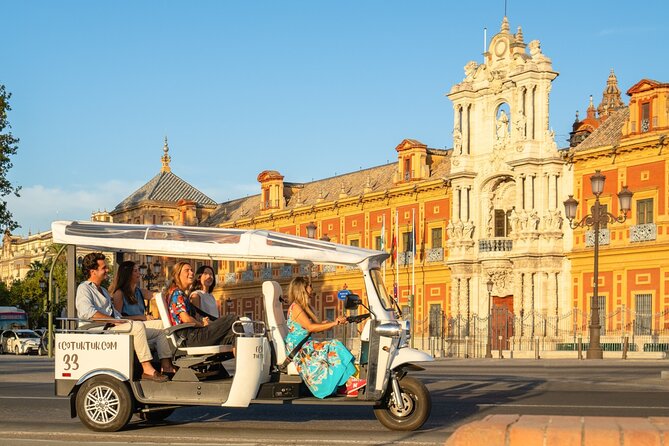
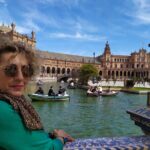
Now for the part you’ve probably pictured already: Plaza de España. This is where the tour earns its express status, because you don’t need a long detour to feel the impact.
The plaza is part of María Luisa Park, and the design is credited to Aníbal González. It was built between 1914 and 1929 for the Ibero-American Exposition of 1929. That theme matters when you look at it: it’s not just a decorative space. It’s the kind of grand planning that turned an event into an architectural legacy.
In the short stop you’ll get here, you can focus on the essentials: the sweeping scale, the central features, and the way the plaza pulls you into a “stand here, frame there” photography rhythm. The tour also keeps this stop efficient, which helps if you’re trying to cover a lot without burning your whole day.
María Luisa Park is your green breathing room, the park often described as one of Seville’s urban lungs. It’s a Historic Garden type protected site, and it was inaugurated on April 18, 1914 as the Infanta María Luisa Fernanda park. That means you’re not just seeing trees and paths—you’re seeing a planned, historic landscape space.
Nearby is Plaza de América, another landscaped area inside the park, flanked by major museums and buildings including the Museum of Popular Arts and Customs, the Archaeological Museum, and the Royal Pavilion. Even on an express ride, that clustering helps you understand why this park area became such a landmark zone.
For the photo-minded visitor, this is often the stop that makes the whole tour feel worth it. The angle, the symmetry, and the color palette all play well with a quick stop—exactly what this tour is good at.




Plaza de América, Torre del Oro, and the Maestranza Bullring
After the park area, the tour continues into a second layer of Seville identity: river heritage and traditional culture.
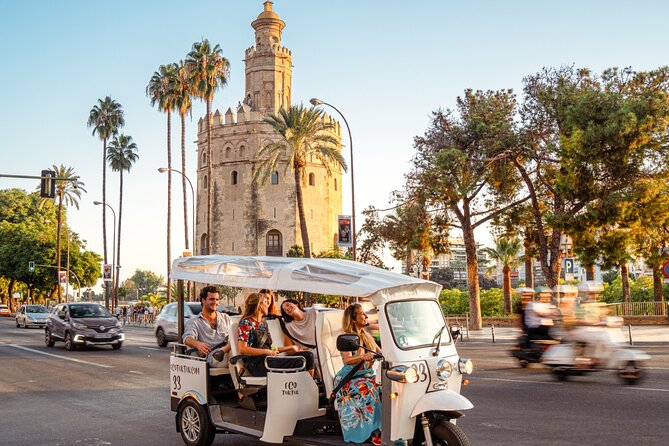
You’ll see the Torre del Oro, a watchtower on the left bank of the Guadalquivir. It dates back to 1221 and stands at 36 meters, with a tower structure made of three bodies. Even if you’ve never studied medieval river defenses, you’ll instantly get the logic: towers like this were about control and watch along a major water route. The river keeps showing up in Seville, and the Torre del Oro makes that connection feel historical, not just scenic.
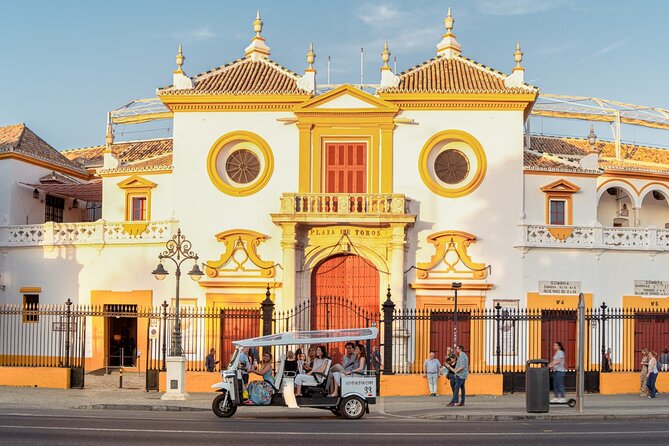
Then comes La Maestranza, the bullring in the Arenal neighborhood. It was built in the 18th century and is owned by the Real Maestranza de Caballería de Sevilla. If you’re curious about Seville’s traditions and how they remain part of modern life, this exterior stop provides a straightforward anchor. You don’t need to be into bullfighting to understand what it represents culturally: a long-standing social institution with a permanent home in the city.
In a short time, you end up with a neat storyline:
- river power (Torre del Oro)
- civic/traditional identity (Maestranza)
- and the modern-seeming highlight plaza (Plaza de España)
That arc is exactly what makes an express tour more than just a checklist.
Price, Comfort, and Small-Group Logistics in Private Eco Tuk-Tuks

Let’s talk value. The price is listed at $42.30 per person, and it’s popular—already booked many times recently. For that amount, you’re paying for three things:
1) Time saved: this is built to reduce walking between distant-looking spots.
2) Guided context: you get explanations while you ride, so you’re not just looking at buildings with no story.
3) Convenience with photo stops: you don’t have to chase exact spots to get good pictures.
It’s also private and eco-themed (eco tuk-tuk), which tends to feel like the “less hectic” version of a bus tour. In at least some cases, people explicitly prefer tuk-tuk over big group transport because you can feel more connected to what the guide is saying and where you’re going.
Comfort-wise, you should feel good about the setup if you have limited mobility. The tour notes that the vehicles are suitable for seniors and that drivers can assist with getting on. There’s also guidance toward moderate physical fitness, which usually means you should be able to handle short photo stops without lots of hiking.
Now the part that can change your total cost: each tuk-tuk maxes at 4 passengers. If you’re a group of five, six, or more, you’ll likely need extra tuk-tuks, and that can make the per-person math less attractive. For larger groups, I’d check headcount carefully before booking so there are no surprises.
Finally, know the constraints. The tour route is fixed and photo stops can’t be modified. If you’re the type who wants to roam freely on your own schedule, this isn’t that format. It’s more like a guided highlights tour with planned stops, not a custom private car tour.
Should You Book This Express Tour of Seville in a Private Eco Tuk Tuk?
I’d book this if you want:
- a high-impact orientation in a limited timeframe
- Plaza de España without the hassle of figuring out timing and logistics
- a private, seated way to see multiple neighborhood textures (Triana, the river area, and major landmarks)
- guides who can bring the city to life, including multilingual drivers such as Juan and Hugo
Skip it (or rethink it) if:
- you have a large group and don’t want to pay for multiple tuk-tuks
- you need total flexibility to customize stops minute-by-minute
- you prefer long museum-style visits rather than short, efficient photo breaks
If you’re on a tight schedule and want the quickest path to understanding Seville’s shape and mood, this express ride is a strong bet.
FAQ
How long is the Express Tour of Seville in a Private Eco Tuk Tuk?
The tour duration is listed as approximately 1 to 2 hours. The 60-minute tour includes a stop at Plaza de España, and the 120-minute tour adds an additional stop at Isla de la Cartuja.
Is the tour private or shared?
This is a private activity. Only your group participates.
Where does the tour start and end?
The tour starts at Parking APK2 ArjonaPuente del Cristo de la Expiración, 746, Casco Antiguo, 41001 Sevilla, Spain, and it ends back at the meeting point.
Can I change the route or the photo stops?
No. The route follows a pre-established path with photo stops at fixed locations, and tours cannot be modified.
How many people can ride in each tuk-tuk?
Tuk-tuks are booked privately, and the maximum is set at 4 passengers per tuk-tuk for the legal limit. Larger groups may need more than one tuk-tuk.
Are babies or young children allowed?
The minimum age is 2 years. Babies are not allowed.
What happens if it rains, or if I need to cancel?
The tours take place in rain or heat and can only be canceled under extreme conditions. If you cancel in advance, free cancellation is allowed up to 24 hours before the experience start time for a full refund.