REVIEW · SEVILLE
Seville Triana Quarter and River Small-Group Walking Tour
Book on Viator →Operated by Seville Unique Experiences · Bookable on Viator
Triana and Seville’s riverfront can feel like one story—if someone tells it right. This small-group walk links landmarks you’d miss on your own with the human reasons behind them. I love how the pace is city-friendly, and I love the way the tour explains what you’re looking at, from the ship-defense tower to Triana’s major church. One thing to consider: at about 90 minutes, it’s a smart overview, not a long sit-down museum visit at each stop.
I also like that the group stays capped at 10, so you get real back-and-forth, not a shouted lecture. Guides such as Marta, Miguel, and Clara have a knack for turning dates and architecture into something you can actually picture. If you only want one church or one neighborhood, you may feel the route is slightly packed, but if you like variety, it lands just right.
In This Review
- Key Highlights You’ll Actually Feel While Walking
- Start at Torre del Oro: A Ship-Defender for the Modern Walk
- The River’s Story Moves Forward: A Modern Monument to Shared Cultures
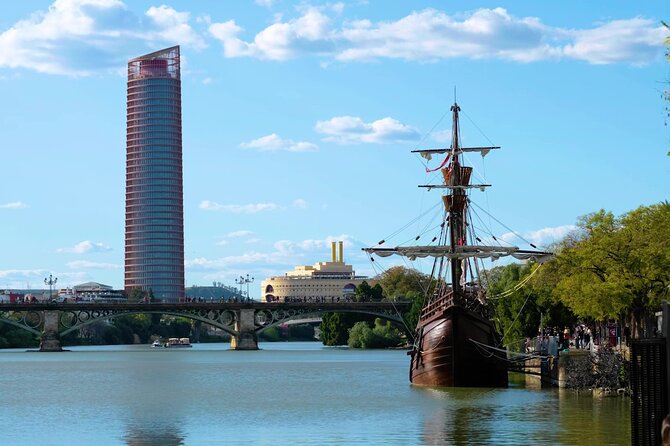
- The 1800s Iron Bridge: From Floating Crossing to Fixed Link
- Triana’s Market: Food, Mediterranean Ingredients, and Local Life
- Crafts and Ceramics: Why Triana Became Known for Making
- Castle of San Jorge: The Inquisition and a Defensive Structure
- A Small Church and Holy Week: Brotherood Traditions on Triana’s Terms
- Triana’s Main Church After 1248: Mudéjar Style and the Cathedral Nickname
- Group Size, Timing, and the Real Cost Value
- Who This Tour Is Best For (And Who Might Skip It)
- A Few Tips to Get the Most From It
- Should You Book the Seville Triana Quarter and River Tour?
- FAQ
- How long is the Seville Triana Quarter and River small-group walking tour?
- What is the price per person?
- How many people are in the group?
- What language is the tour offered in?
- Do I get a mobile ticket?
- Where does the tour start?
- Where does the tour end?
- Is confirmation provided after booking?
- Are service animals allowed?
- What is the cancellation policy?
Key Highlights You’ll Actually Feel While Walking
- Cap of 10 people keeps the tour personal and easier to ask questions
- Guadalquivir river links to Triana so the geography makes sense fast
- Iron bridge from the 1800s gives you a clear before-and-after story
- Market and ceramics stops show how everyday goods shaped the neighborhood
- Castle of San Jorge and the Inquisition connection add a darker, important layer
- Holy Week church visits and Mudéjar architecture connect faith, art, and local identity
Start at Torre del Oro: A Ship-Defender for the Modern Walk
Most Seville walks start with pretty streets. This one starts with purpose. You begin at the Golden Tower—Torre del Oro—on the river. It’s an old watchtower built to defend access for ships coming toward the city. That matters because Seville’s river isn’t just scenery. It’s the reason the city grew, traded, fought, and eventually split into neighborhoods with their own identities across the water.
From the first moment, the tour helps you see the river as a system: movement, control, and community. You’ll get a guided sense of why this part of town mattered long before the streets became romantic for visitors. And since the route runs through both sides of the Guadalquivir, the walking feels like you’re getting the full picture, not just a single viewpoint.
Value-wise, starting here sets the tone. You’re paying for context, not just walking between photos.
You can also read our reviews of more walking tours in Seville

The River’s Story Moves Forward: A Modern Monument to Shared Cultures
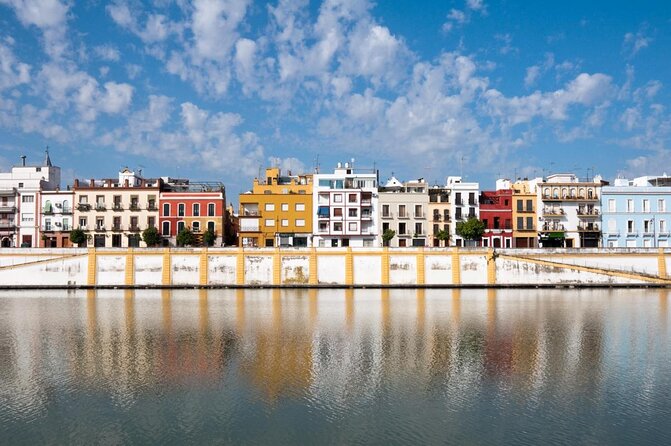
After the watchtower, you shift toward a modern monument that points to something Seville is known for but often gets oversimplified: different cultures coexisting across centuries. The point isn’t just to check off a landmark. It’s to give you a framework for what Triana became—an area shaped by trade and people moving in and out over time.
Seville’s story has layers, and this stop acts like a hinge. One side is the defensive, practical past. The other side is the more human “how did people live together?” question. It’s an efficient way to keep the tour from turning into a list of dates.
Practical note: this section is short, but it gives you a mental map. I find it helps you enjoy the later stops more, because the tour keeps referencing the same big ideas.
The 1800s Iron Bridge: From Floating Crossing to Fixed Link
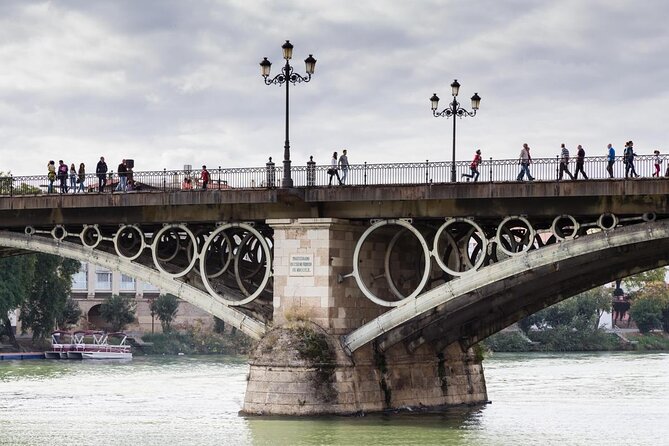
Then you reach the first fixed bridge in Seville—built to replace an earlier floating bridge that connected the city with Triana. This is one of those history details that sounds dry until the guide frames it as a neighborhood turning point. A fixed bridge changes how people move. It changes daily life. It changes commerce. It changes which side feels like the center.
What I like here is the emphasis on engineering style—iron architecture from the 1800s—because it anchors the story in something you can look at, not just read about later. You’ll see the bridge as a physical statement about the era: modernization, durability, and control over crossings.
If you like architecture and infrastructure (and even if you don’t), this stop is a strong “aha.” It’s also a nice pacing break: you pause, you look, and then the tour turns back toward people and places.
Triana’s Market: Food, Mediterranean Ingredients, and Local Life
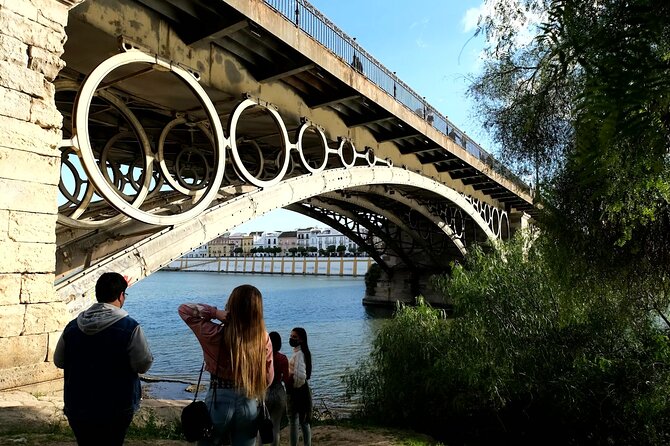
Once you step into Triana’s traditional market area, the tour changes gears from structures to stuff you can almost smell. You’ll talk about the products of the neighborhood and how they contributed to Mediterranean cuisine.
This is where I think the tour offers real value for food lovers. It’s not a cooking class and you’re not promised tastings, but you’ll leave understanding what the market represents: local supply, seasonal patterns, and the way a community eats shapes its identity. Triana isn’t just “the other side of the river.” It’s a place with its own rhythms.
You’ll also likely pick up practical ideas for dining later. Even when the tour doesn’t name specific dishes, it helps you understand what to look for—markets and stalls that reflect the neighborhood’s focus rather than generic tourist food.
If you’re the kind of traveler who likes to read a city through daily life, this market stop is a highlight.
Crafts and Ceramics: Why Triana Became Known for Making
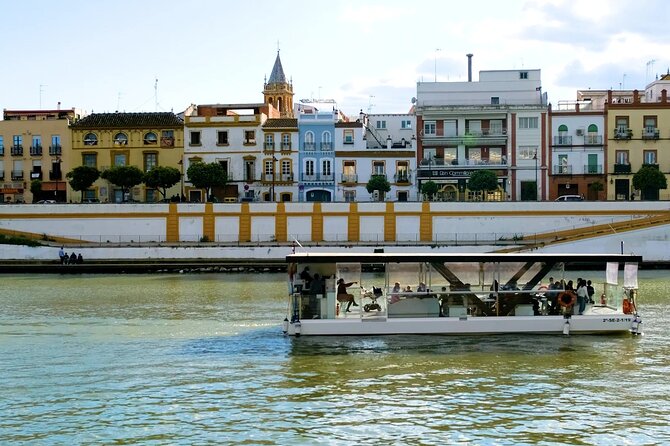
Next comes the crafts side of Triana, with a focus on ceramics and traditional artisan workshops. This isn’t just a sympathetic sidebar about artistry. The tour frames craft as work, identity, and exportable skill—something that helped make Triana relevant beyond the neighborhood.
Ceramics connect neatly to what you’ve already learned: the river as a trade route and the market as a source of materials and demand. The guide ties those dots for you, so it feels like one story instead of five unrelated stops.
This is also where a good guide really shows. Guides like Marta have a way of explaining context without turning it into a lecture. And with small groups, questions land naturally: you can ask how the craft developed, why certain styles mattered, and what ceramic-making tells you about the community.
If you’re choosing between this tour and something that’s only “big monuments,” I’d pick this one if you want a more human Seville. The city’s grand buildings are impressive. But craft shows you how people lived and expressed themselves every day.






Castle of San Jorge: The Inquisition and a Defensive Structure
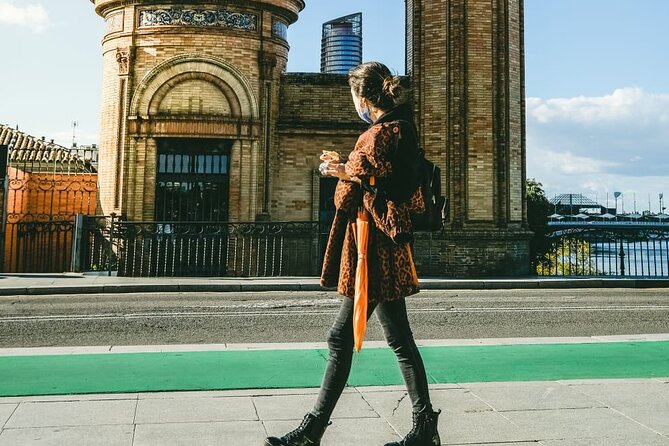
Now the tone turns serious. You enter the Castle of San Jorge, described as the only defensive structure of the area. That “only” detail matters because it makes the site more than a pretty backdrop. It’s where power concentrated.
Even more important, the tour discusses the castle as headquarters of the Inquisition, and it explains why this religious court was significant in local history. This is not the light, sunny Seville people come for when they want palaces and tapas. But it’s also part of the city’s real story.
What makes this stop work is how it’s framed. Instead of sensationalizing, the guide uses the setting to show how institutions operated and how fear and control could shape daily life. In my view, that context helps you understand Triana’s later religious landmarks too.
If your travel style avoids heavy topics, you can still handle it. The tour keeps it focused. But it is a reminder that “historic” can also mean difficult.
A Small Church and Holy Week: Brotherood Traditions on Triana’s Terms
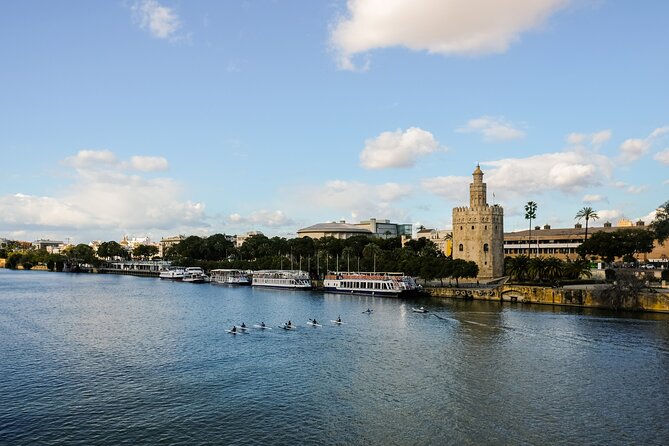
From the castle, you head to a smaller church tied to one of Seville’s most important religious festivities: Holy Week. This chapel is described as a stop that’s still mandatory for visitors focused on Triana’s brotherhoods.
Here, the tour makes faith feel local rather than generic. The guide connects the setting with what Holy Week means in Triana—who participates, why these sites matter, and how tradition shapes community identity. It’s one of those experiences where architecture and ritual become inseparable.
I love when tours handle religious sites respectfully and clearly. This one does. You’re not asked to “believe” anything. You’re asked to understand why the place is important and how it ties to the neighborhood’s sense of self.
Also, the stop gives you a useful contrast. You’ve just been at a fortress of power. Now you’re in a space of devotion and tradition. That swing helps the whole itinerary feel balanced.
Triana’s Main Church After 1248: Mudéjar Style and the Cathedral Nickname
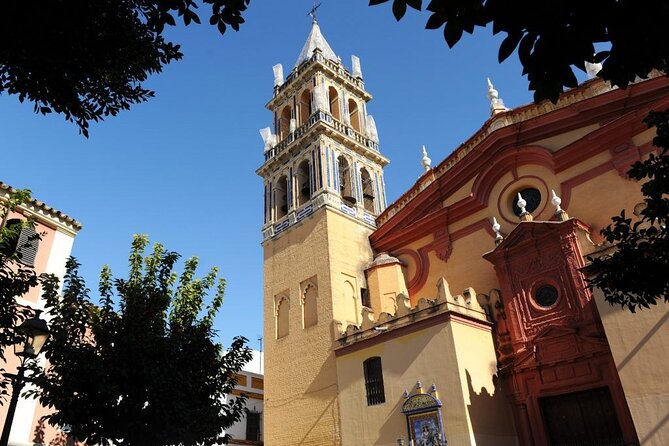
The walk ends at the Real Parroquia de Señora Santa Ana. This is Triana’s most important church, and the tour explains that it was the first built after the Christian conquest of 1248. You’ll also hear why it’s admired for its Mudéjar architecture style—and why it’s popularly known as the Cathedral of Triana.
Mudéjar style is one of those topics that can sound like jargon until someone connects it to what you can actually see: how artistic influences overlap, how design choices reflect historical contact, and how styles travel between cultures. This stop turns that concept into something tangible.
Ending here feels satisfying because it ties the itinerary together. You started with defense and navigation along the river. You traced modernization through the iron bridge. You learned about everyday life via the market and ceramics. Then you faced the neighborhood’s darker institutional past. Finally, you finish with faith and art—still very much alive in the community.
It’s a strong “bookmark” for the day, especially if you plan to keep exploring Triana after the tour.
Group Size, Timing, and the Real Cost Value
At $30.04 per person for about 90 minutes, this tour isn’t trying to be cheap. But it is trying to be fair. You’re paying for a guided thread that links eight distinct stops into one coherent story. For many visitors, that’s the difference between seeing a bridge and understanding why it changed a neighborhood.
The group cap at 10 people also affects value. With fewer people, guides can respond to interests—food, architecture, religious sites, or the darker historical layers. Based on the way guides like Marta, Miguel, and Clara are described, the experience tends to feel conversational rather than robotic.
You can also pick morning or afternoon start times, which helps if you’re planning around heat, church hours, or your own walking rhythm. It’s not a full-day commitment. It’s a smart add-on when your schedule is tight.
Who This Tour Is Best For (And Who Might Skip It)
This is a great fit if you love history but you don’t want it presented like a textbook. You’ll get narrative structure: river control, neighborhood identity, market life, craft traditions, and major religious landmarks.
I’d especially recommend it if:
- you want a fast, story-driven orientation to Triana
- you like architecture with explanations tied to real life
- you care about how Seville’s past shaped what you see today
You might skip it if:
- you want mostly major cathedral-style interior time and long museum stops
- you prefer tours with lots of free time to wander without guidance
A Few Tips to Get the Most From It
Bring comfortable walking shoes and keep your camera handy. The tour moves through several distinct “modes” (defense, modernization, food, crafts, institutions, faith), so you’ll get the most if you’re present and watching for connections.
If Holy Week interests you, plan around the fact that the itinerary includes a dedicated church stop linked to that tradition. And if ceramics are your thing, arrive curious. The tour’s craft focus makes it easier to recognize what you’re looking at when you’re back on your own.
Should You Book the Seville Triana Quarter and River Tour?
If you’re the kind of traveler who wants to understand a place instead of just walking through it, book it. The combination of a capped group size, multiple big themes in a short time, and guides with a talent for clear storytelling makes this one easy to justify.
With an overall rating of 4.8 and 93% recommending the experience, it’s not just a “nice walk.” It’s a guided route that gives you a working knowledge of why Triana looks and feels the way it does—starting from the Torre del Oro and ending at Triana’s Mudéjar masterwork.
FAQ
How long is the Seville Triana Quarter and River small-group walking tour?
It runs for about 1 hour 30 minutes.
What is the price per person?
The price is $30.04 per person.
How many people are in the group?
The tour has a maximum of 10 travelers.
What language is the tour offered in?
The tour is offered in English.
Do I get a mobile ticket?
Yes, you’ll receive a mobile ticket.
Where does the tour start?
It starts at Torre del Oro (Golden Tower), P.º de Cristóbal Colón, s/n, Casco Antiguo, 41001 Sevilla.
Where does the tour end?
It ends at Real Parroquia de Señora Santa Ana, Párroco don Eugenio, 1, 41010 Sevilla.
Is confirmation provided after booking?
Yes, you receive confirmation at the time of booking.
Are service animals allowed?
Yes, service animals are allowed.
What is the cancellation policy?
Cancellation is free if you cancel up to 24 hours in advance for a full refund. Changes within 24 hours aren’t accepted.